Sliding Sands to Palikū Cabin Loop

Sliding Sands to Palikū Cabin Loop

Haleakalā National Park, Hawaii

Length: 19mi (30.6km)
Days: 2
Difficulty: Moderate (well maintained trail, exposure / weather risk, rough terrain, significant elevation change over short distances)
Gear: Standard
Completed: March 2023

In summary: Fitting a trip to Haleakalā into a Hawaii vacation is no simple feat, especially if you plan to spend a night in the crater. The summit area of the volcano is a few hours from any of the island’s major tourist centers, and most travelers opt to fill their suitcases with bathing suits as opposed to camping gear. Still, it is an experience worth making time for. Stepping into the Haleakalā Crater is akin to landing on a foreign planet. Almost instantly, one forgets the blue waters and sandy beaches of which Hawaii is known and starts to wonder at the isolated, ruddy landscape that is like nowhere else on Earth. As you hike along you may find yourself asking: Is this what Mars looks like? Am I walking through a cloud right now? Was Jurassic Park filmed here? Few two-day treks can match the Sliding Sands to Paliku Hut Loop in terms of diversity of scenery and terrain. Despite its brevity, this trail should not be considered a cakewalk. Sharp and unstable lava rock litter the crater floor, weather conditions are notoriously unpredictable, and the grade of the trail entering and exiting the crater is severe. Nevertheless, spending a night on Haleakalā is an unforgettable experience, and I can promise that if you are the type of person who enjoys reading this blog, you will not regret forfeiting a day or two of your beach time.


The Route


Preparation / Know Before You Go

This route requires a short hitchhike: If you want to turn your trip into a loop instead of a lollipop, you will need to catch a short hitchhike between the Haleakalā Visitors Center and either the Halemau’u Trailhead or Hosmer Grove Campground. While this is optional, I would highly recommend it as the stretch along the Halemau’u Trail is one of the best sections of the park. The hitch itself should not pose you too much trouble if you exit at the Halemau’u Trailhead as there is a designated pickup area and signs notifying drivers there may be hikers in need of a ride. For context, it took us ~10 minutes a hitch. We also picked up a hiker on our way up to the summit who told us he had been waiting ~30 minutes.

Reservations are required for overnight stays: By design, there are very few campsites within the Haleakalā Crater. If you want to experience the magic of an overnight stay, you will want to reserve a permit well in advance. Reservations can be placed for the cabins ($75/night) or adjacent campgrounds (free) on Recreation.gov. Per usual, we stayed in the campground.

Bring a filter: The Haleakalā campgrounds offer very basic services to minimize environmental impact. There are pit toilets and water spigots. The water from the spigots is considered non-potable; thus, overnighters should bring water treatment devices.

Prepare for inclement weather: The weather atop Haleakalā is notorious for being unpredictable. It tends to be 20-30°F (11-17°C) cooler on the summit than at sea level, and conditions can change in a matter of minutes. Over the course of our journey we alternated between walking through rainclouds and dealing with intense sun. Haleakalā may be one of the few 2-day hikes where sunscreen and a rain jacket are equally necessary.


Day One: Haleakalā Visitor Center to Palikū Cabin (8.9mi)

Our trip to Haleakalā started, like any other, at the crack of dawn. Though I conveniently had plans to bring my bag, tent, and other necessities with me on our trip to Hawaii (it was meant to be a restful little vacation before starting the AT), there were a handful of necessities that we had to purchase on island, most notably a Walmart sleeping bag for Emma. This proved easy enough, but did set us back an hour or two as we raced across the island and up to the top of the volcano. Winding our way towards the summit area by car, we passed a smiling hitchhiker holding out a crisp $20 bill. In an effort to build up some good karma, we stopped and gave him a free lift to the top. He had just finished a similar hike to the one we were planning and needed to get back to his car.

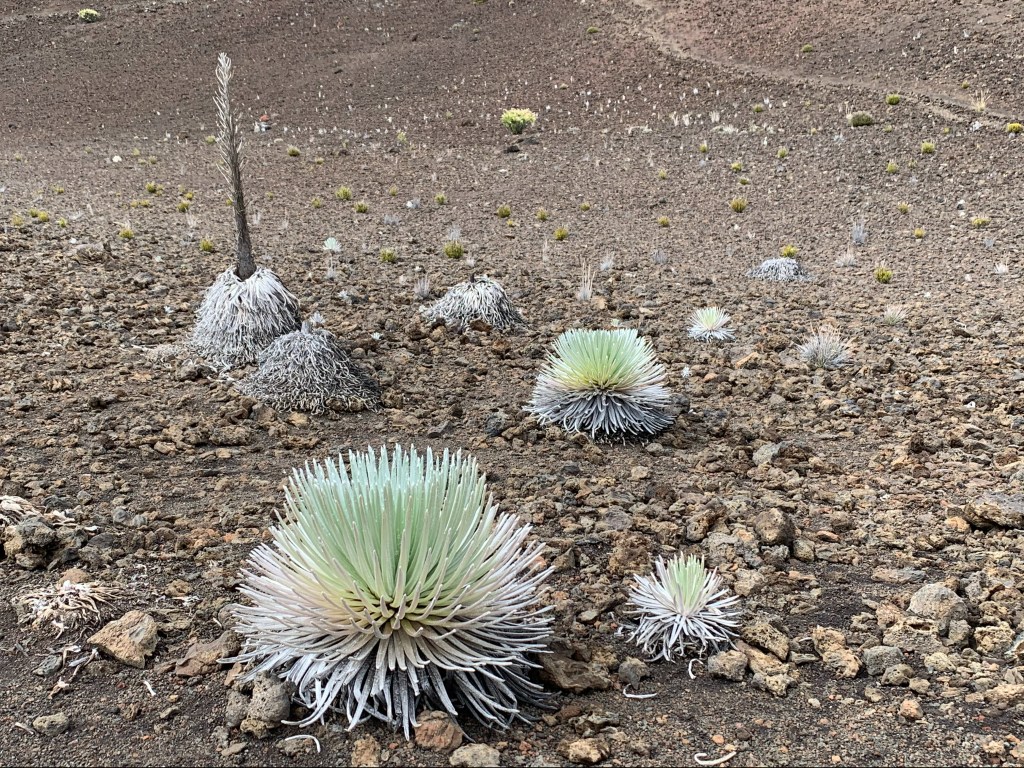
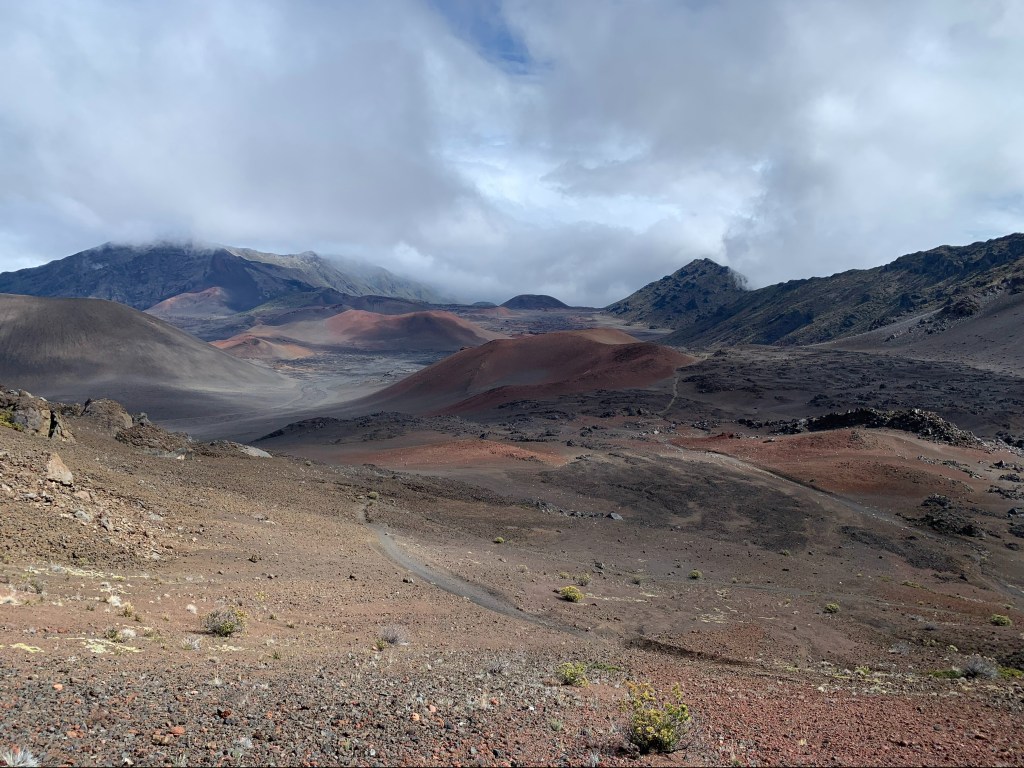
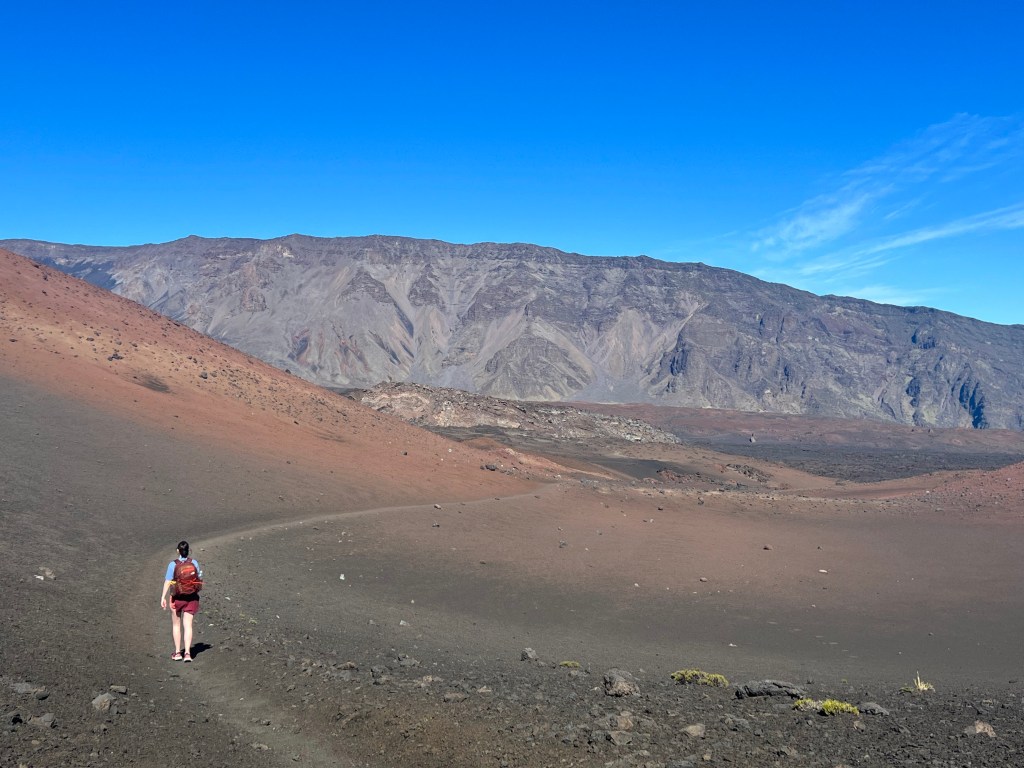
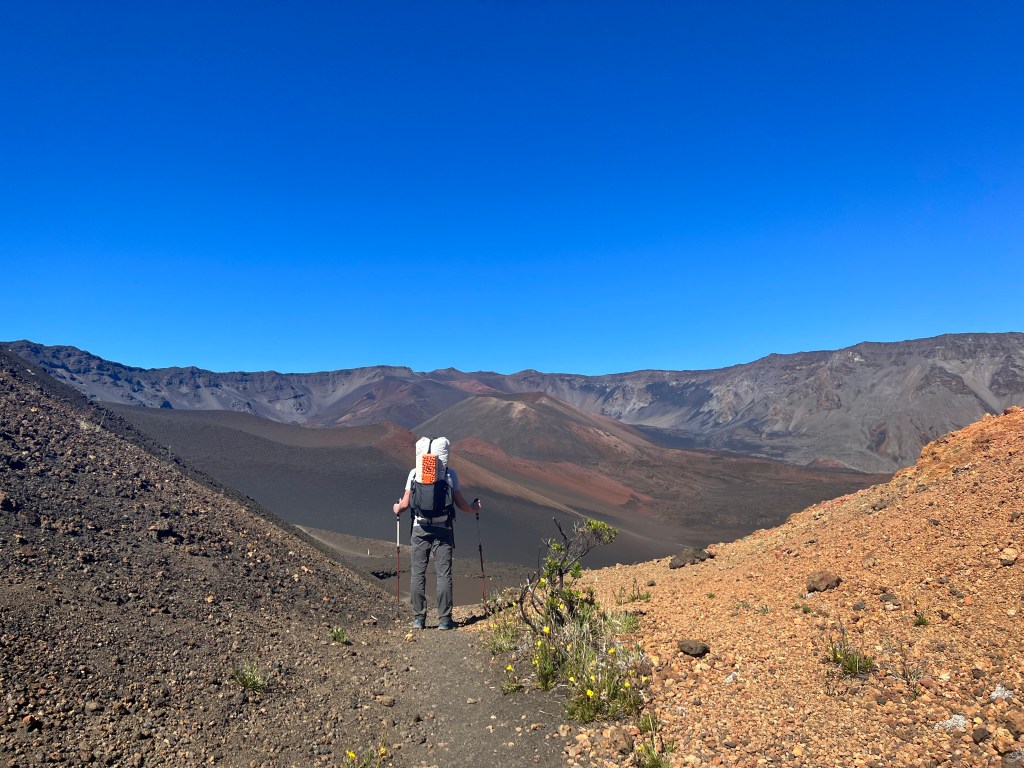
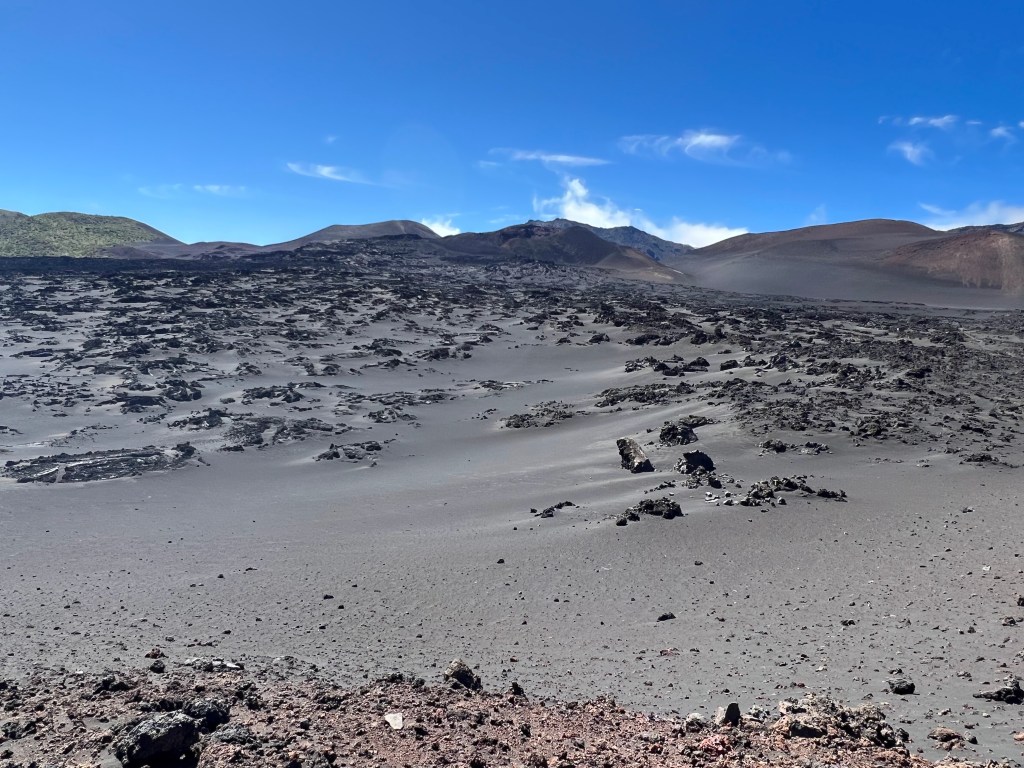
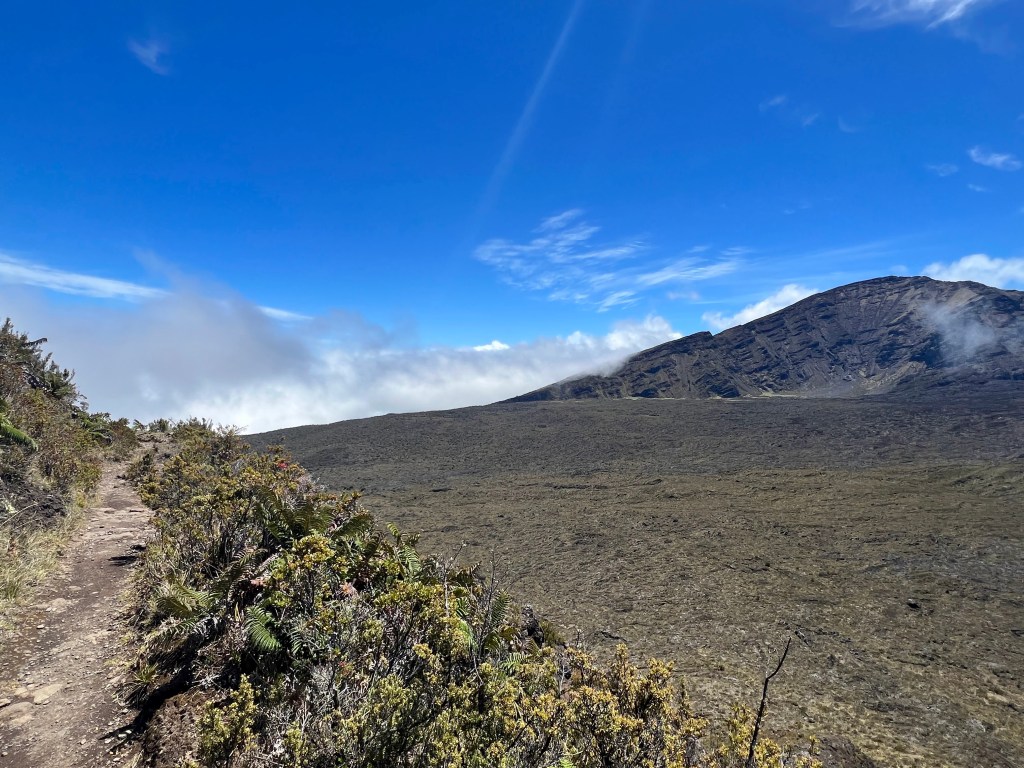
By the time we reached the mountaintop trailhead and had all our gear in order, it was around 1:00pm. As usual, we would be starting later than we had hoped. Fortunately, we were to begin with a few miles of downhill walking that afforded an opportunity to gain back some time. As we left the parking lot and stepped into the crater, we were struck by the same breathtaking scenery that had captivated us a couple of years prior. Thick clouds were swirling inside a melting pot of colorful stone. From above, the landscape looked smooth and coordinated. Clear lines separated red rock from brown, as if Pele herself had painted the volcano. Only as we descended could we grasp just how rough and inhospitable the landscape really was. Loose, sharp rock littered the crater floor and the ground was noticeably devoid of plant life, save for tiny wildflowers, scraggly bushes, and intermittent patches of the regal Hawaiian Silversword.

For those that have never seen a Hawaiian Silversword, they are a spectacular endemic plant evolved to survive in one of the harshest environments on earth. The endangered sub-species atop Haleakalā are only found on the volcano, generally growing in patches of green and silver rosettes where human or animal activity did not manage to wipe them out. As we descended deeper into the crater we could spot the dead and dry stalks of the select few plants that had bloomed earlier in the season. Silverswords may live up to 90 years and when their time comes, they go out with a final colorful display. A stalk covered in purple flowers suddenly emerges from the center of the plant and may rise as high as 6ft. before the whole plant dies and the seeds are left to scatter across the barren landscape. We had missed the bloom by a few months, but it provided a reason to return, just as our desire to sleep in the crater had driven us to back to the park this trip.

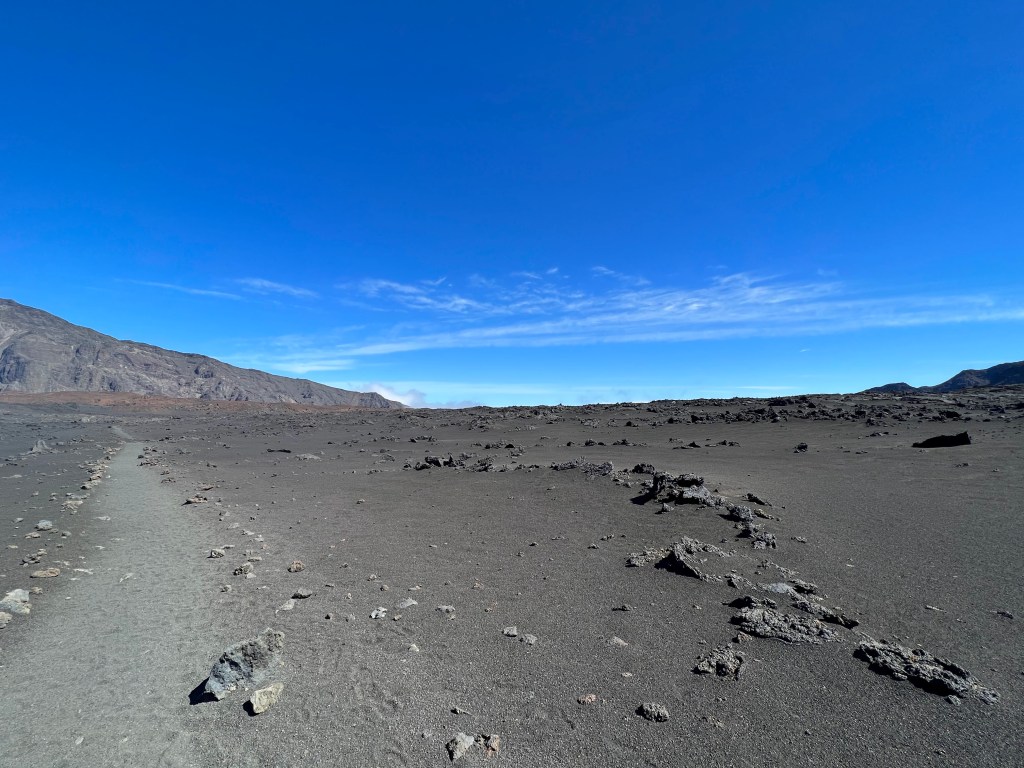
Having been to the crater before on a day where the weather was more cooperative, we hustled through the downhill section of the hike until we reached the bottom of the crater roughly four miles in. It was here a lone, weathered tree and a fork in the road marked the spot where we had turned around on our last hike. Only this time, we stayed true to the Sliding Sands trail and followed the signs towards the Kapaloa Cabin. This section of trail was pleasantly flat and remarkably barren. It was like an interplanetary journey between the smooth grey rock of the Moon and the ruddy orange of Mars. As we neared the cabin, there were two notable shifts in the environment. Firstly, thick clouds moved in that blocked out the sun and created the feeling that it was much later than it was. Though it never truly rained, it took minutes before everything we had was thoroughly soaked. We were like Silversword, pulling moisture directly from the clouds. The second gradual change was in the scenery. Near the cabin a layer of bleached green shrubs began to carpet the crater floor. As we passed further into the crater the undergrowth grew thicker. It appeared rough lava rock had taken the place of the dense volcanic ash on the crater floor, providing enough texture for plant life to gain a foothold.

After an hour of walking through a wet fog, the wind shifted and the cloud dispersed as quickly as it had come. Once again, we were trekking along under the blue Hawaiian skies, now enjoying a comparatively lush section of the trail. Within minutes the added visibility came in handy, for it allowed us to spot another one of Haleakalā’s rare, endemic species, the Nene or Hawaiian Goose. The mating pair was posing on a prominent lava rock, alert, but unperturbed by our presence. For minutes, we sat and watched the beautiful birds. Nene are the rarest species of goose in the world, and remarkable in that even though they are capable of flight, they almost never take to the air. This odd behavior obviously did not contribute well to their survival as colonization and globalization introduced hunting, feral cats, mongoose, and other threats to the islands. This drove the population down to around 30 birds by the 1950’s, though there are believed to be a couple thousand on the archipelago today.

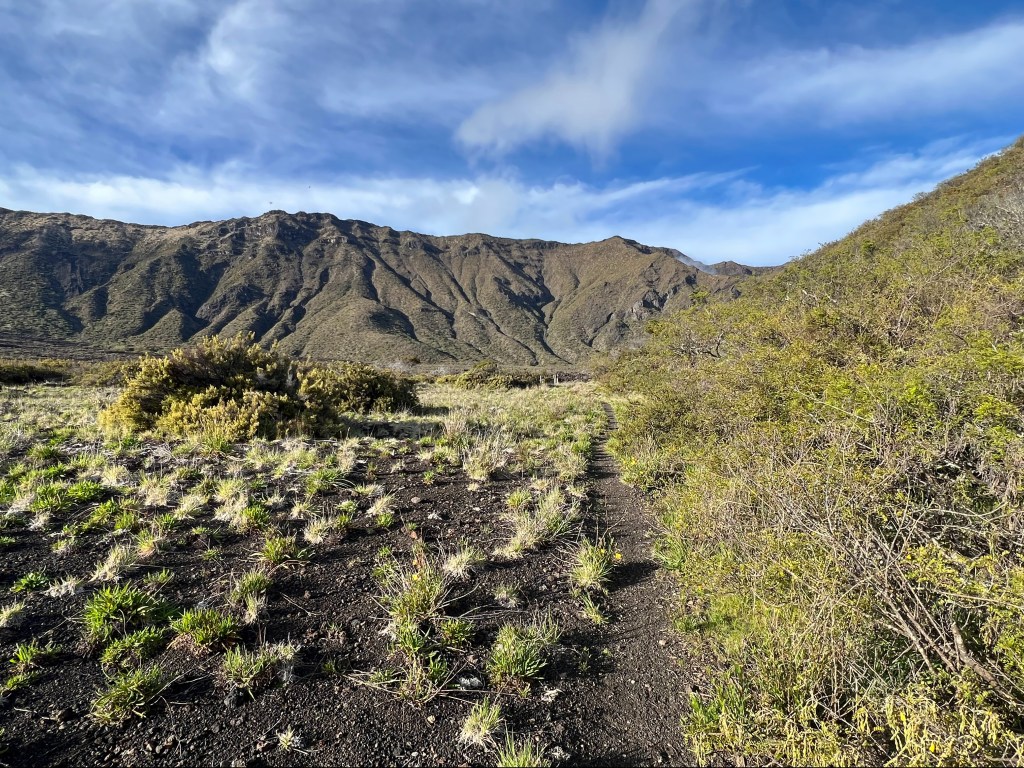
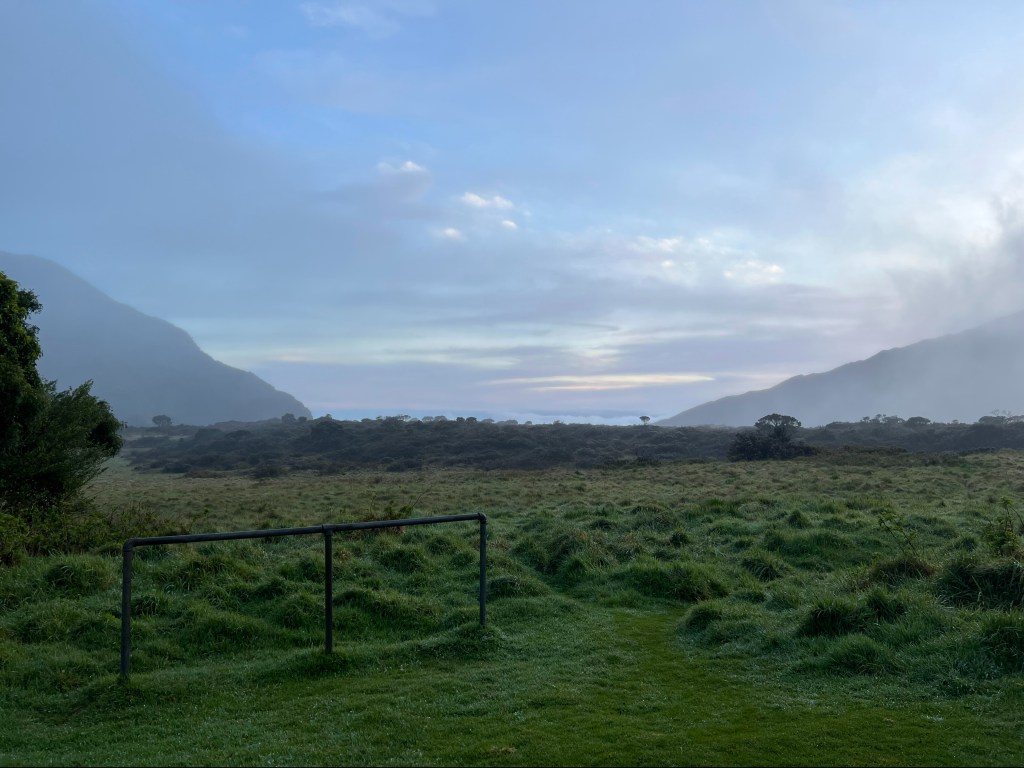
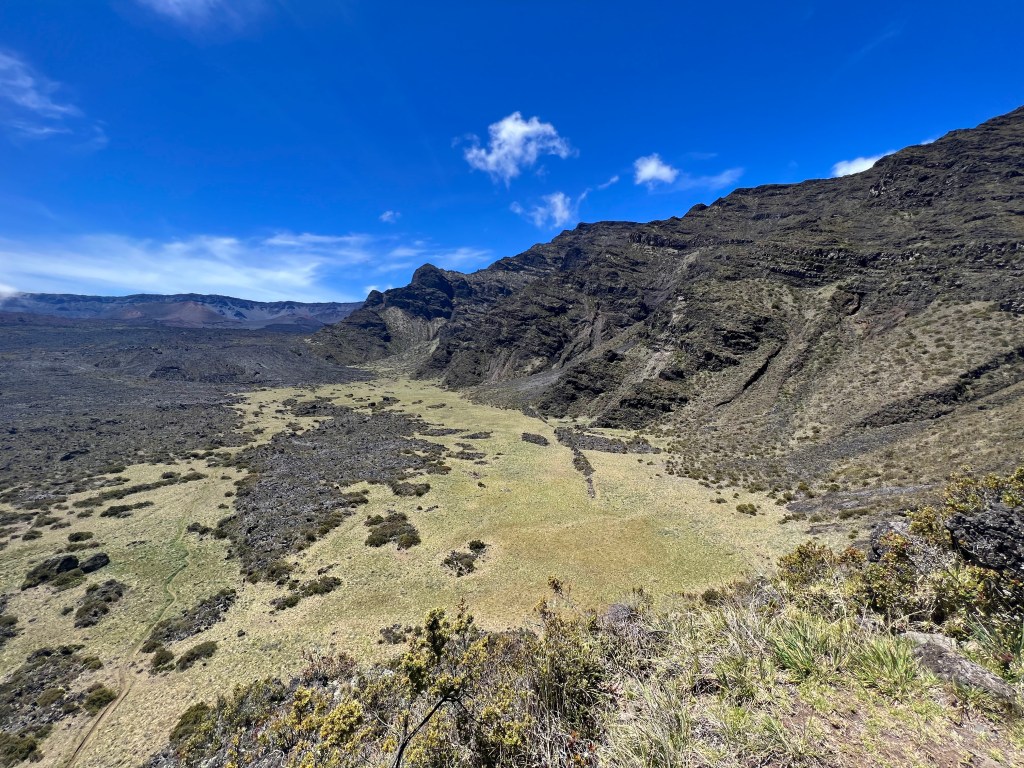
Eventually, we bid farewell to our Nene friends and continued on our journey into the late afternoon. It wasn’t long before we encountered another goose, this one standing right in the middle of our path. He was considerably less friendly than the mating pair and refused to yield even as we patiently waited for the right of way. After a few minutes, we nervously shooed him off trail and continued on towards the Kaupo Gap. After rounding a sizeable cinder cone and making a small descent, we arrived in the gap. It was like a scene out of Jurassic Park. Tucked in amongst imposing, sheer cliffs was a small cabin surrounded by lush foliage. A thick grove of trees hugged the wall and crowded into small ravines as far up the escarpment as they could reach. A thin layer of fog hung in the valley, creating a spooky effect as the sun dipped below the walls of the caldera. We set up our tents then poked around a bit and chatted with our neighbors staying in the cabin. While conversing, a family of six Nene waddled out of the tall grass and began feasting on the green shrubs along the trail.

Darkness comes quickly atop Haleakalā and with it came a thick layer of clouds that brought a chill to the crater floor. We stayed up as long as we could in hopes of catching a magnificent starscape, but eventually drifted off and fell into a deep, well-earned sleep. It had been a long day, and we had an early morning ahead of us. We also were fully aware that we would need to earn back most of the 3,400ft. we had descended.


Day Two: Palikū Cabin to Halemau’u Trailhead (10.1mi)

At some point in the middle of the night, I stirred enough to remember to poke my head out of the tent and take a look at the sky. The Hawaiian volcanoes of Haleakalā, Mauna Loa, and Mauna Kea are known as some of the best spots in the world for stargazers, and I was blown away by what I saw. Though a layer of fog prevented a full view of the sky, a couple clear windows were filled with a dazzling display of stars. It was a difficult feeling to describe, one that I find myself in pursuit of on backpacking trips. In a quiet, remote location surrounded by natural beauty, I felt for second as if I was the only person on Earth. Eventually the chilly mountain air drove me deeper into my sleeping bag and back asleep.

Our hiking day started with the calming sounds of the morning breeze on our rainfly and a thousand little songbirds singing their way up and down the escarpment. Hoping to get some beach time in later in the afternoon, we took down camp quickly and departed early. There to greet us on the trail was the same angry Nene, approximately a mile out from the Paliku Cabin. This time he was even more steadfast in his aggressive defense of the trail. As we cautiously approached hoping to shoo him off, he hissed like a cat and beat his wings. It was quite possible he’d chosen a poor, high-traffic spot for a nest, but this gave us even more reason to stick to the trail. Eventually, I worked up the courage to bluff charge the brave bird, and he stepped off trail just far enough for us to scurry through.

With a little boost of adrenaline to wake us up, we retraced our steps around the O’ilipu’u cinder cone and back to the green covered lava fields. The terrain in this section was particularly rough, and while carefully watching our feet to avoid a tumble onto the sharp rock, we almost forgot to look back behind us. When we did, we were amazed by what we had seen. The morning fog had retreated, and now the clouds hung at the top of the escarpment. Periodically, a gust of wind would spill the white mist over the edge of the cliffs and into the crater, where it would quickly dissipate into nothing. The blue skies also provided a clear view through the Kaupo Gap, across the Pacific Ocean, and all the way to Mauna Kea on the Island of Hawaii approximately 100 miles away. It was a sight to behold.

Pushing forward again we took a right turn at the junction and hopped on to the Halemau’u Trail to explore a section of the park that was new to us. Compared to other areas of the crater it was particularly rough and rocky. In fact the trail led us across sections where the ground was so rough that plant life appeared unable to conquer it. As we gradually pushed uphill, however, the trail smoothed out and eventually we found ourselves back on the smooth Martian rock that we had looked out over from the top of the volcano the afternoon prior. This allowed us to pick up the pace again, and soon we were passing by Haleakalā landmarks such as the ‘Bottomless Pit’ (aka Kawilinau, a 65 ft. deep lava tube) and ‘Pele’s Paint Pot’ (a hillside smeared with streaks of particularly vibrant colored lava rock). The best part was, since we got an early start we had the crater and landmarks to ourselves. The day’s visitors still driving the long road to the summit or starting their long descent into the crater via the Sliding Sands Trail.

It wasn’t until we passed the Silversword Loop and reached the Holua Cabin that we finally encountered some other hikers. There we stopped to filter some water and have a snack. It was late morning by this point and starting to heat up. There was no semblance of shade in the crater so we packed a little extra water and hit the road, hoping to complete our climb out of the crater before the temperature neared the daily highs. Beyond the cabin, the trail led us through one of my favorite sections of the park, where an ancient lava flow had cascaded across the crater floor and spilled down the side of the volcano. We walked alongside imprinted lava tubes and bubbles of solid rock, staring out over the Ko’olau Gap. From where we stood, a flat plain seemed to stretch for another mile or so until, abruptly, the world ended. As we began our steep climb up the walls of the crater, the effect became even more pronounced. It was as if the edge of the Earth stood before us, go over it, and you would just disappear into the clouds below.

Though just about 2 miles from the parking lot, our work for the day had really just begun. We were facing a climb up to the crater rim across a brutal stretch of switchbacks rising well over 1,000ft. in elevation. It was hot out at this point but we powered through, fueled by ever more expansive and impressive views of the crater below. Covered in sweat, we eventually reached an viewpoint known as the Rainbow Bridge, and for the final time admired the crater from which we had come. Satisfied and feeling accomplished, we hiked a gradual half mile out to the hiker pick up point and started hitchhiking. Within 10min, a convertible pulled over with a family inside. They only had room for one, so I grabbed the keys and hopped in for an enjoyable open air ride on a sunny day. A thick layer of clouds covered the lowlands, but we towered above. If felt like I was riding on the wing of an airplane. At the top, I bid farewell to my knew friends, grabbed the car, and began a long ride back to society, picking up Emma along the way.


Alternate Itineraries

There are a web of trails that cover the Haleakalā Crater and create several opportunities to customize your route. The primary decision one has to make is where to finish your hike. We elected to optimize for both scenery and simplicity of logistics by wrapping at the Halemau’u Trailhead. That being said, you could finish at the other trailheads

  • Summit (Keonehe’ehe’e Trailhead): This option makes the trail a true loop and removes the need to hitchhike altogether. It does however, bypass the Hōlua Cabin and Ko’olau Gap wilderness area entirely which is a very scenic and unique part of the crater.
  • Hosmer Grove Campground: Finishing at Hosmer Grove increases the route length, but does make for a potentially difficult hitchhiking situation as the trailhead is off the main route to the summit.

I should also note that one can also begin their hike at any of these three trailheads. In fact, beginning at the Halemau’u Trailhead is commonplace as it allows hikers to knock out the steepest section of the trail while going downhill. Still, I strongly recommend beginning at the summit as the descent into Haleakalā crater is magical.

Alternate route – Kaupo Gap: A significant variation on the route is to follow the Kaupo Gap Trail from the Palikū Cabin down the mountain and to the coast. This allows for exploration of a new section of the park and provides the satisfaction of going all the way from summit to sea, or sea to summit if you prefer a masochistic climb. Fair warning, much of the Kaupo Gap trail is outside the National Park boundary and is known to be poorly marked and maintained. It also is a bit of a logistic nightmare as the Kaupo region is notoriously difficult to get to from the more populated parts of the island. While we originally set out to follow this route, we were dissuaded after reading accounts such as the one by Halfway Anywhere.

Additional Sources

Minong Ridge Trail

Minong Ridge Trail

Isle Royale National Park, Michigan

Length: 50.9mi (81.9km)
Days: 5-6
Difficulty:
Hard (no facilities, isolation, rough terrain, and bugs)
Gear: Standard + GPS/PLB recommended
Completed: June 2022

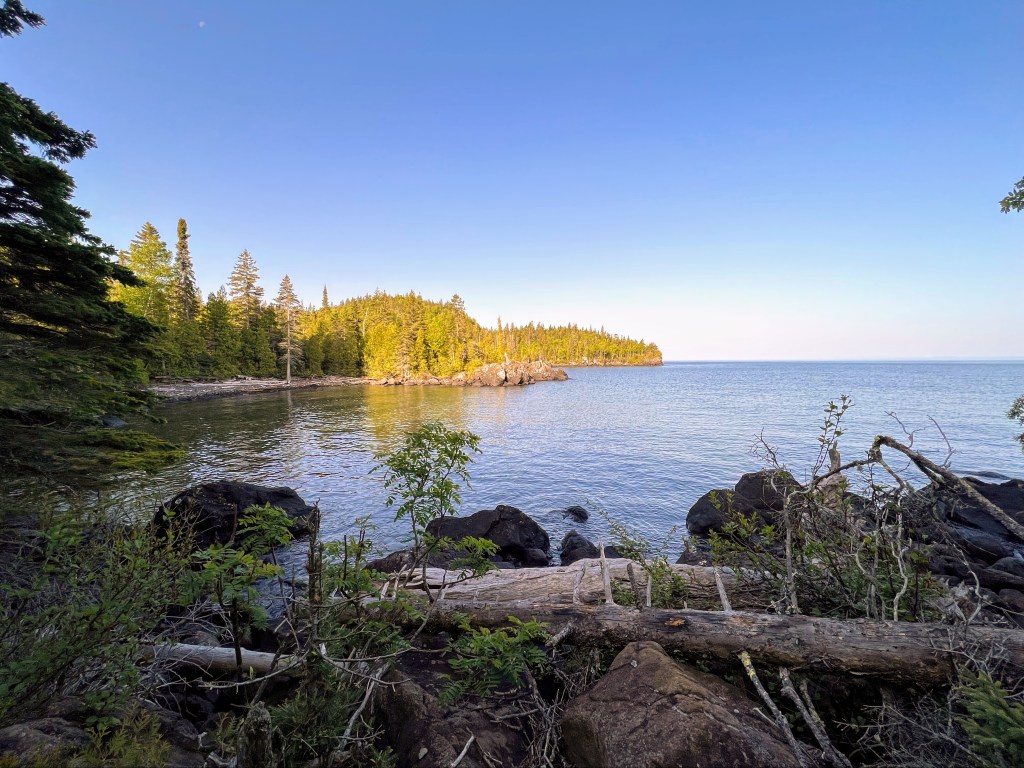
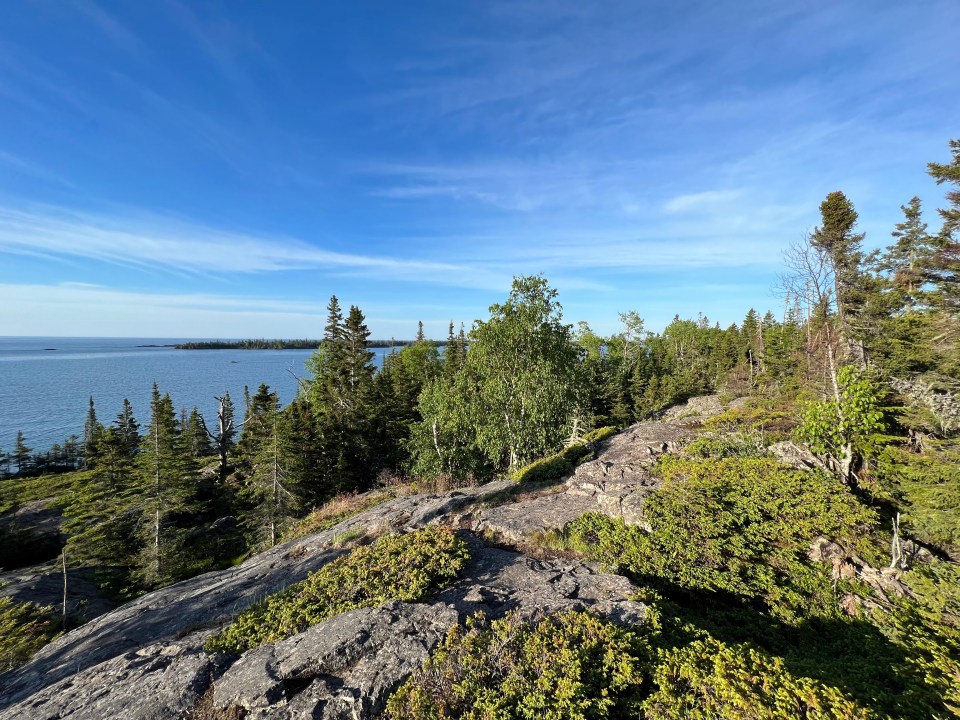
In summary: At any given time there are likely more moose on Isle Royale than there are hikers, and that about sums up all you need to know about the Minong Ridge Trail, especially if you are an avid backpacker seeking solitude within an increasingly crowded parks system. Few places in America outside of Alaska or the Greater Yellowstone Ecosystem are better for spotting wildlife (we enjoyed double-digit moose sightings), plus the surrounding island scenery isn’t too bad either. The Minong is regarded as the isle’s most rugged and challenging backpacking route, which only adds to the adventure. You might battle through long travel, bugs, unpredictable weather, and real elevation swings, but the opportunity to camp under the northern lights on a remote island largely unblemished by human activity is worth it a thousand times over.


Preparation / Know Before You Go

Book your travel to the island well in advance: There are only two methods for getting to the remote Isle Royale, one is expensive and the other is quite time consuming. Despite the cost, I am a huge promoter of the Isle Royale Seaplane as it is by far the most convenient way to access the isle. Unlike the ferries, the seaplanes run seven days a week and offer multiple departure times over the course of the day. Also, unless you have access to a private boat, the park can only be accessed from three mainland towns: Grand Portage MN (ferry & plane), Houghton, MI (ferry & plane), and Copper Harbor, MI (ferry only).

The park closes seasonally: Isle Royale is only open each year from April 16 – October 31, making it one of just a handful of national parks that close seasonally. The timeframe for visiting may be even shorter if you don’t have access to a boat though, as the ferry and seaplane have even more constrained operating seasons. These seasons are weather dependent, but generally run from around mid-May through the end of September.

Bring bug spray & bug nets: Hordes of mosquitoes and biting black flies are present on the island and their presence tends to correspond with the peak visitation season from June to July. Experienced visitors recommend treating clothes and gear with permethrin spray before arriving on the island, but we were able to survive with DEET-based bug spray. There exist some pretty dramatic accounts of the Isle Royale bugs, but with copious amounts of OFF! we found them to be a tolerable nuisance. Bug nets add an extra layer of protection and go a long way for providing peace of mind.

Do not rely on the weather report: I don’t believe there is a weather station on Isle Royale and my hypothesis is that when you search the park on a weather app it is pulling data from Houghton, MI over 70mi. away. We had planned for a week of dreary rain based on our 10-day forecast and instead found ourselves battling through 90F heat on exposed ridges. The reading from Grand Portage, MN might be your best bet for an accurate forecast, but in reality, you should be prepared for anything.

The northern lights: The opportunity to see the northern lights (or ‘aurora borealis’) with minimal light pollution is a huge draw to the island. The timing of the borealis, however, can be difficult to predict. Visibility depends on a number of factors including cloud cover and the current sun cycle. Though it is imperfect, the best predictive tool I have found for measuring your chances of seeing the lights is this dashboard from NOAA. Hopefully you have more luck than us.

Pronunciation: You will hear all sorts of pronunciations of the park’s name, even from local Michiganders, but the technically correct one is “eye-el royuhl” not “eye-el roy-al”.


Day One: Windigo to Huginnin Cove (4.6mi)

All adventures to Isle Royale begin well before the trailhead. For us, it began in the parking lot of Isle Royal Seaplanes, condensing our packs, weighing our gear, and steeling ourselves for what had the potential to be a bumpy plane ride through stormy conditions. In actuality, our journey had started 6 months earlier as we tried to figure the logistics of getting to the least visited national park in the lower forty-eight. For the purpose of the retelling however, I will skip over that part.

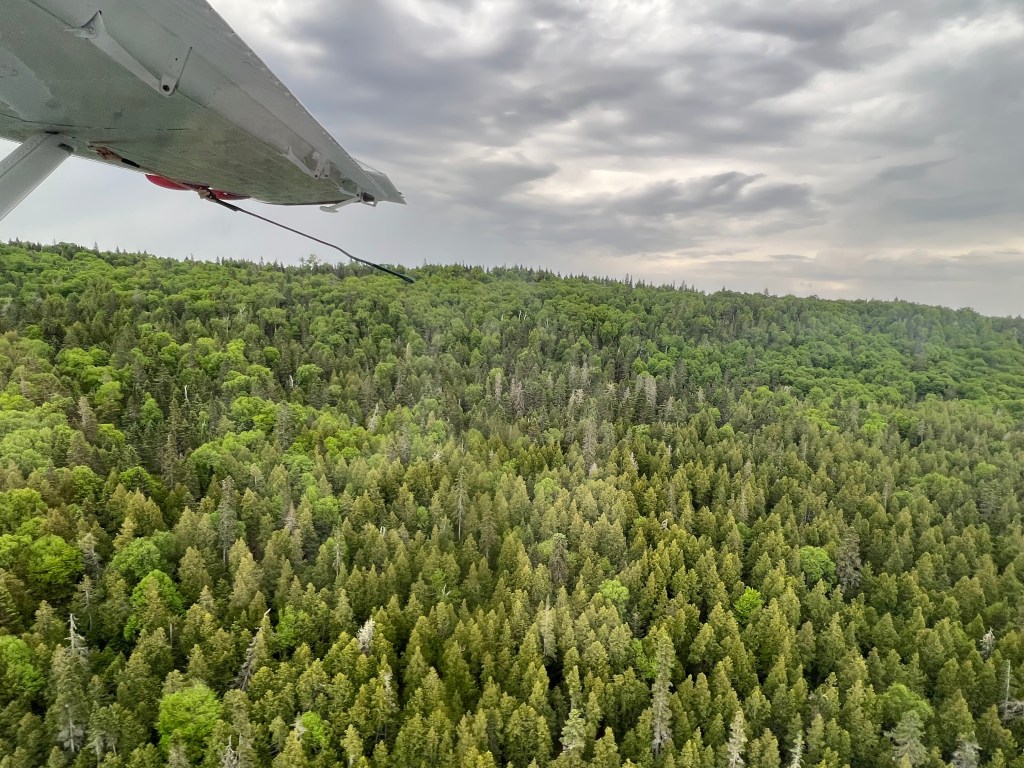
Promptly 15 minutes before we were scheduled to depart on the last flight of the day, we watched as our plane appeared over the nearby hills, narrowly cleared the nearby Portage Canal Bridge, and landed in the water right in front of us. A dirty, but happy, group of hikers clambered out, still reminiscing about their time on the island. Right after them came the pilot, who imparted to us the importance of packing up rapidly so that we could be wheels up before the looming storm reached Houghton. Not wanting to relive my experience in New Zealand, we acquiesced and were soon a few thousand feet above Lake Superior, watching distant lightning strikes through the plane’s window.

After approximately 25 minutes in the air, the Isle Royale started to come into view and pending another 15, we found ourselves rounding the mouth of Washington Harbor and preparing to land. As we descended, the pilot pointed out a nearby bald eagle’s nest, at which point an adult eagle flew the coop and passed directly under our plane. It felt like an omen, an auspicious start to an unforgettable trip.

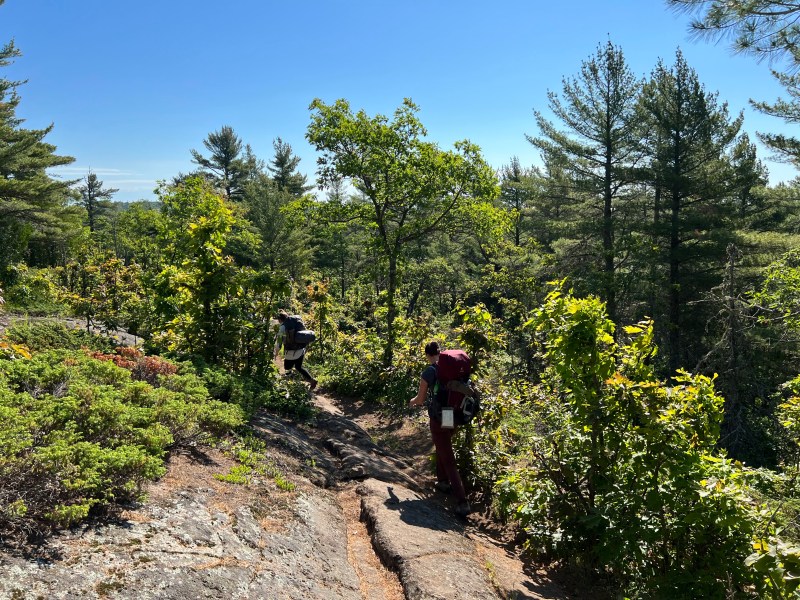
Once docked at Windigo, we popped into the small general store to register our trip and purchase some fuel. With supplies procured we made a quick exit, hoping to get a few miles in and reach Huginnin Cove before it got too dark. Already it was approaching 5:30pm and the overcast made it feel even later. The long summer days of northern Michigan would ensure that daylight was never an issue on the Minong Ridge, but none the wiser we hustled to the trailhead. Almost immediately, we were swallowed by the island’s thick boreal forests. Shrouded under the dense canopy we wove our way around Washington Harbor and began to follow a narrow ravine to the island’s western coast. Along the way, we talked excitedly about what was ahead and our desire to spot a few members of the island’s famous moose population.

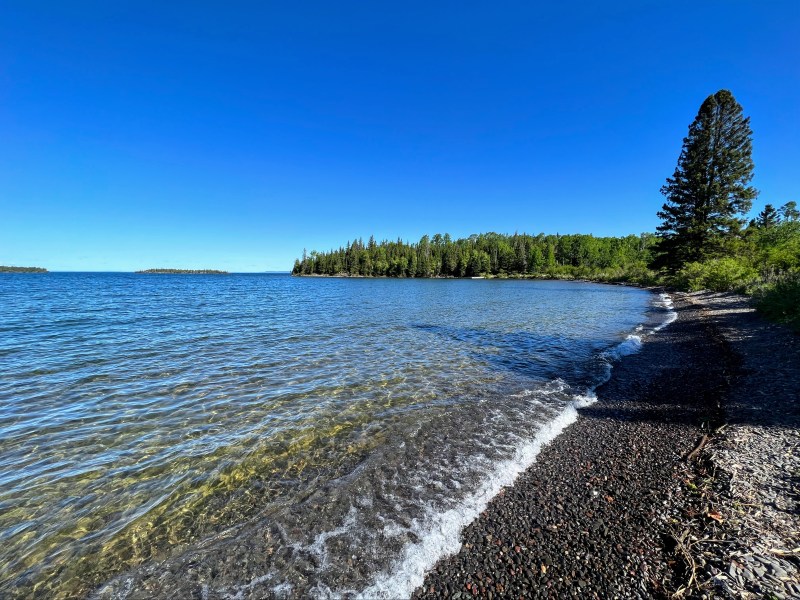
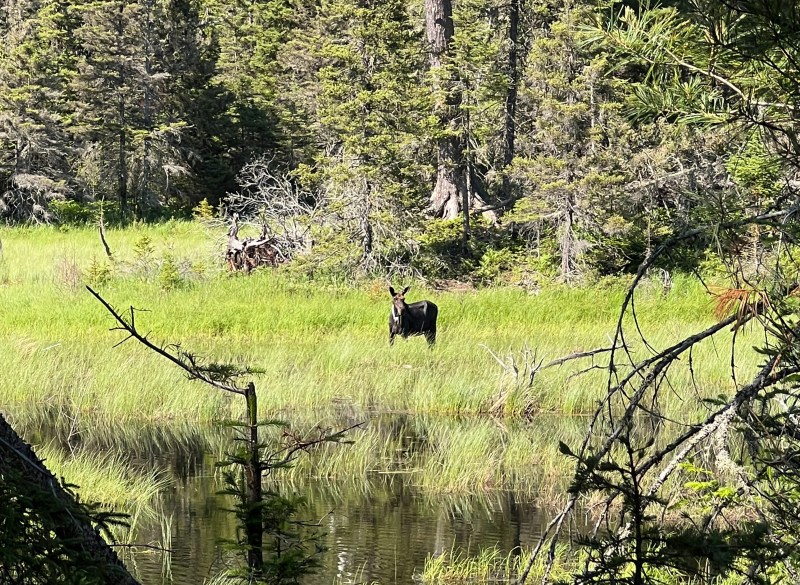
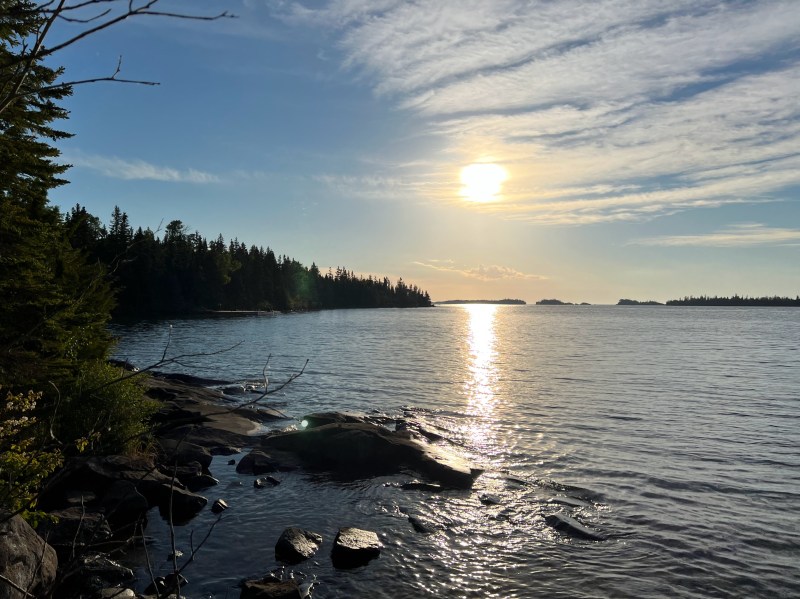
To our surprise, it didn’t take long at all. Only an hour or so in, we found ourselves standing face-to-face with a young cow no more than 20 meters away. We nearly missed her. As we talked and walked on by the moose had stood frozen, patiently waiting for us to pass. It wasn’t until she was almost behind us that we noticed a large figure watching us from just beside the trail. After a split-second of panic, we paused to watch the beautiful creature. Eventually, she became comfortable with our presence and began grazing, working her way over a grove of saplings until the prime leaves led her out of sight. It was an incredible moment, but its reign as the highlight of the day lasted only until we arrived at Huginnin Cove. There we enjoyed dinner and a magnificent island sunset from our beachfront campsite. To this day, the spot remains amongst the best sites I have had the privilege of staying in.


Day Two: Huginnin Cove to North Lake Desor (13.9mi)

There are few better ways to start a day than waking up at dawn to the meditative sound of gentle waves at your own private beach. Had I had a mattress and a real pillow, I may never have gotten up. The hard ground takes its toll however, and after a few minutes of relaxation, we unzipped our tent and stepped out into the pre-dawn light. A pot of coffee and pack of oatmeal later, we were on our way along Isle Royale’s western shore. Before reconnecting with the main route of the Minong, we enjoyed a few miles of scenic coastal walking, accentuated by natural arches, sea stacks, and uninterrupted views of the Minnesotan-Canadian coastline. The decision to weave the Huginnin Cove loop into our journey along the Minong was one we made at the last minute, but I would highly recommend it to anyone else looking to maximize their time on the island.

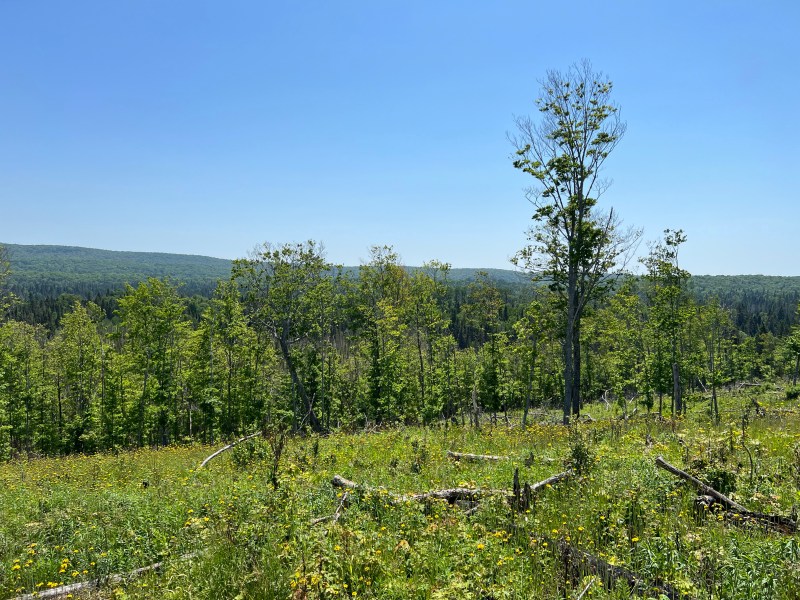
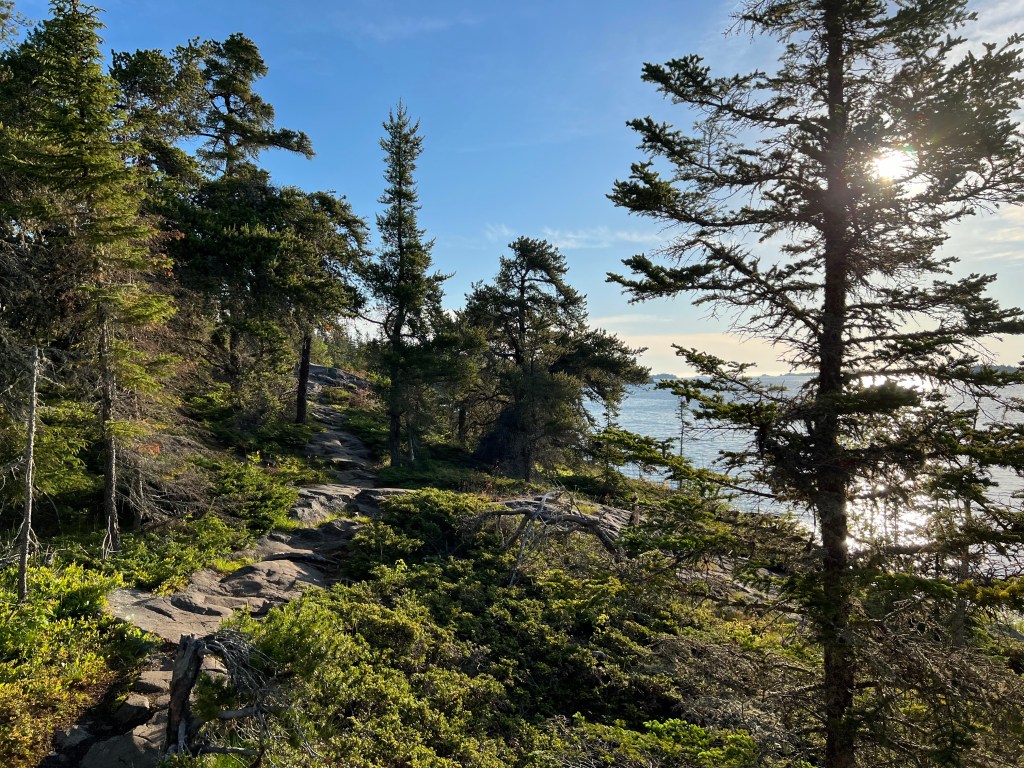
Just before we arrived at the trail’s junction and officially stepped foot on the Minong Ridge, our day really started. Abruptly, the trail pointed us away from the coastline and up a gnarly switchback. Again, we were making our way into the heart of the thick northern forests that seemed to blanket almost the entire island. For the next couple miles, we would track the thin dirt path through the woods until the trees gradually began to thin and we appeared atop a rocky clearing. A look down upon the forest canopy below signaled that we were now on the Minong.

Spoiled by the gentle grade and coastal breeze of our morning mileage, we were soon forced to adjust to “the ridge” portion of the trek. What had steadily led us up almost immediately sent us back down. Little did we know, this exhausting pattern of ascents and descents would come to define the remainder of the day.

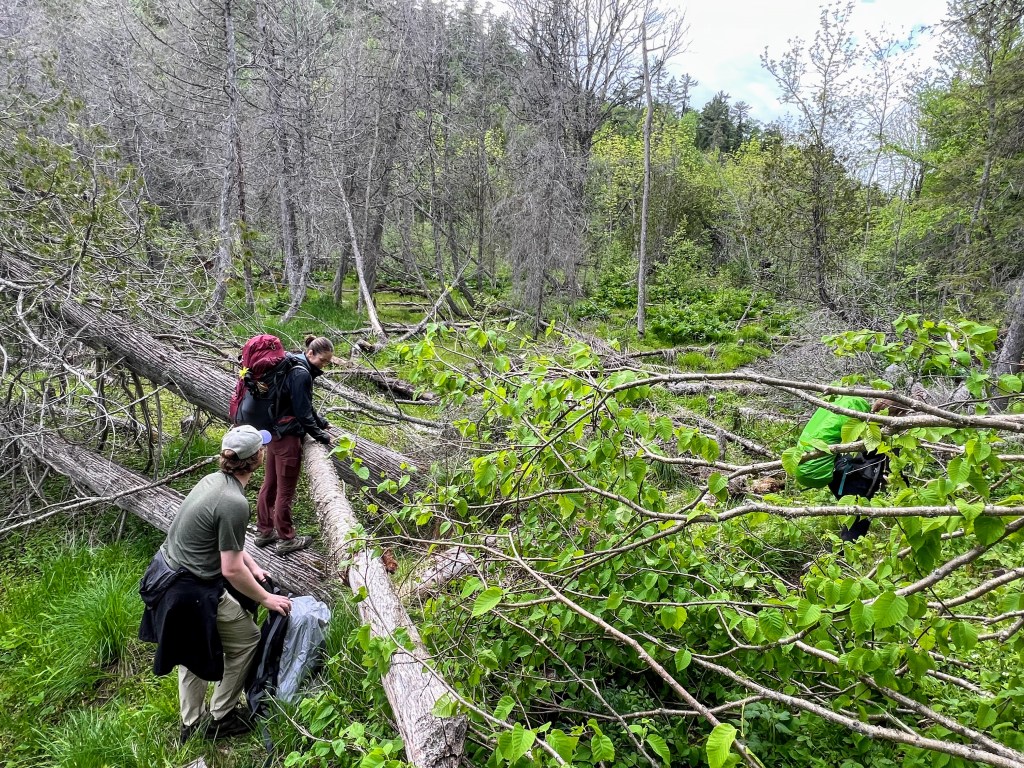
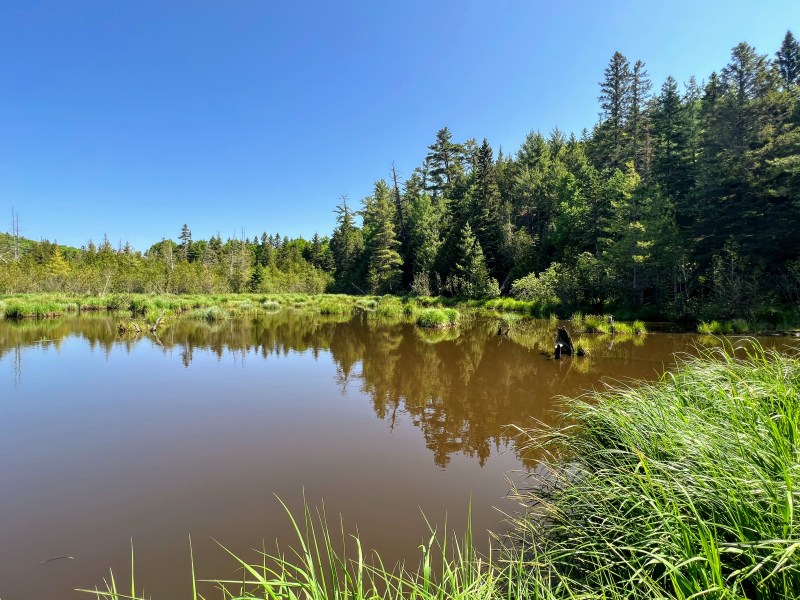
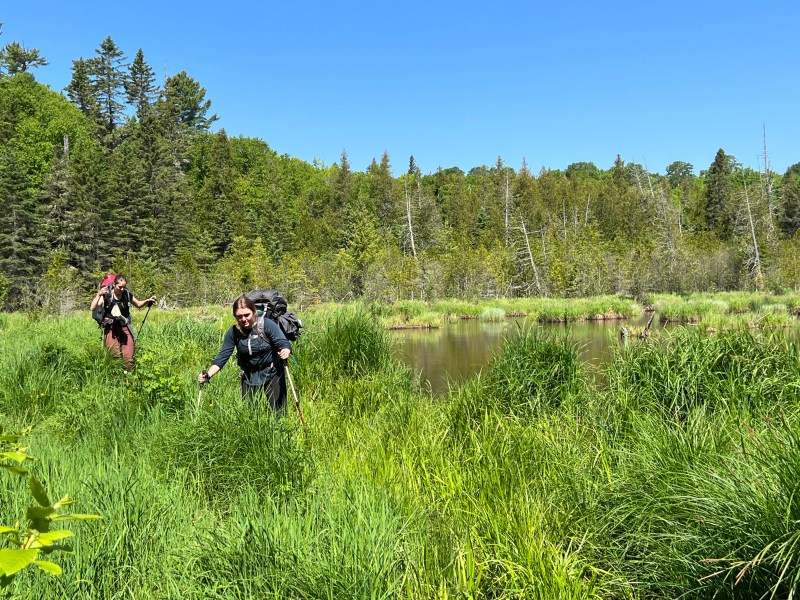
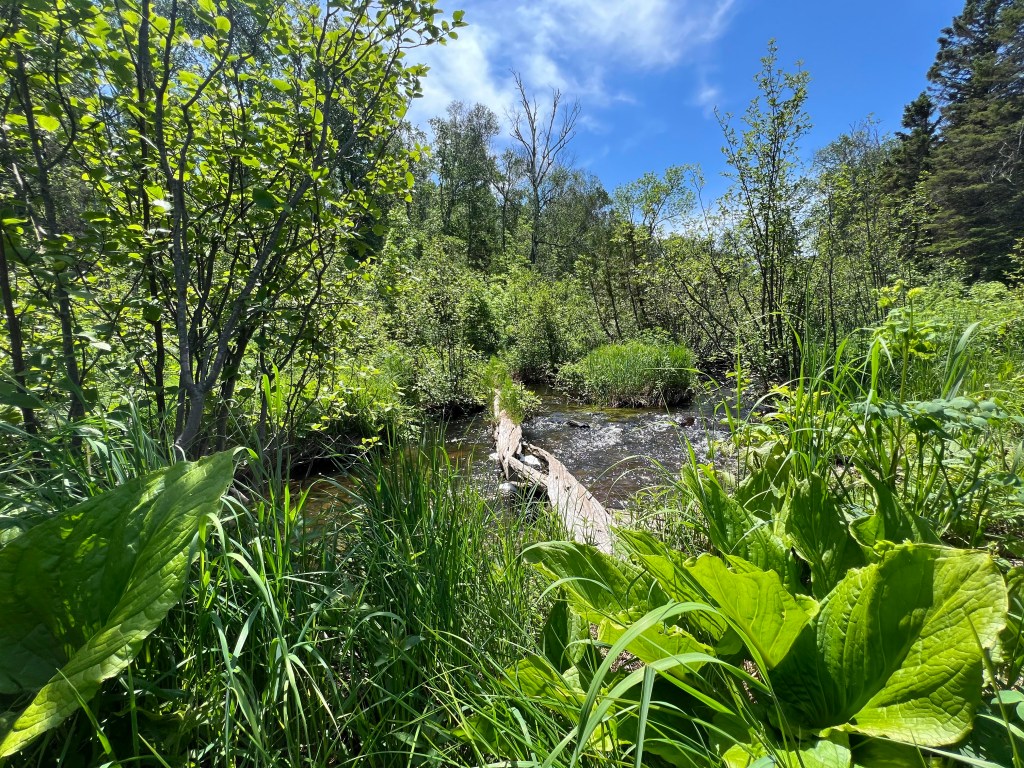
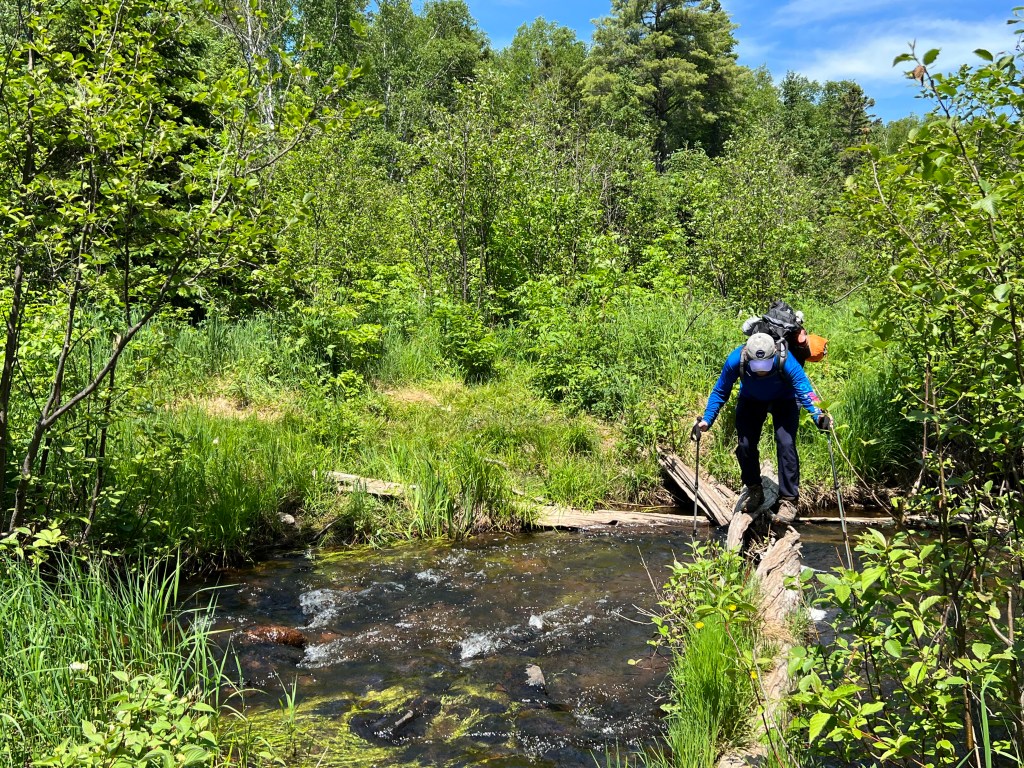
At the bottom of our first “bump” along the ridge, we came across a beaver pond, and to our surprise, the trail led us right across the top of the dam. This dam wasn’t so much a pile of sticks as it was a line of logs reinforced by tufts of tall grass. Thus, a crossing was possible but exceptionally tedious. Our walking sticks offered little help as they simply plunged through the muck when leaned on for balance. Just when we thought we all would make it safely across, Jordan suddenly lost his footing and found himself knee deep in the swamp. A new pair of socks and a lot of laughs later, we regrouped and were on our way again.

Through the remainder of the day, we soldiered on, steadily chipping away at our mileage and hoping for an early arrival at Lake Desor. The sun was out, and the set of exposed ridges offered little respite from the building heat. When stopping for water or to empty gravel from our boots, we often were forced to make a difficult choice between baking on the ridge or facing a swarm of mosquitos in the buggy lowland shade. Nonetheless, it was another memorable day on the trail. We added to our moose tally (surprising one that was headed our way on the trail), enjoyed several panoramic viewpoints, honed our dam-crossing abilities, and best of all, experienced everything in near-total solitude.

By the time the heat and constant change in elevation really began to wear us down, a sliver of blue peeked through an aspen grove due east, giving us our first glimpse of Lake Desor. This proved to be the morale boost necessary to propel us over the last few bumps and down into camp. We rounded out the evening with a well-earned meal and rejuvenating soak in Lake Desor.


Day Three: North Lake Desor to Todd Harbor (10.7mi)

Sunrise at Lake Desor could not have come soon enough. The more I have hiked over the years, the more I have come to believe that there is a sort of supernatural force governing life on the trail, enforcing a sense of balance. Climbs are followed by descents, easy miles by hard, and in this case a great night’s sleep was followed up by a restless one. Despite being relatively close to the water, we lacked the cool coastal breeze that made Huginnin Cove so peaceful. That made for a muggy evening that I, in particular, suffered through. Still, it was nothing that a strong cup of black coffee couldn’t fix.

The hiking began almost exactly how it had ended the day prior. Doubling back out of camp, we climbed our way right back onto the bumpy Minong Ridge route. Whatever grogginess that lingered from my poor night’s sleep was soon shaken off as the early mileage tested our cardio. Fortunately, we were able to sneak a couple of the harder morning miles in while a thin fog cooled the isle.

After traversing a handful of steep bumps and passing by the largest beaver dam I had ever seen, the fog began to burn off and the temperatures steadily rose. On the bright side, this brought improved views of Lake Superior and the Canadian shoreline across the way. To pass the time during ridgetop snack breaks, I began using my Isle Royale map, Garmin InReach, and questionable sense of direction to make dubious claims about the landmasses we were looking at in the distance. By the end of the hike, plans to visit Thunder Bay and Sleeping Giant Park for our next backpacking trip were in motion.

Another memorable moment from one of our day three snack breaks occurred when we heard a peculiar noise echoing from a valley below. Curious, we scanned the swampland and thick forests a few hundred feet below before we saw the movement of a moose grazing on the edge of a shallow pond. Every so often she would stop and let out a deep bellow. On the second or third instance of these calls, we saw movement again, out of the tall grass came a small calf. Thrilled, we watched as the calf awkwardly wobbled through the swamp to rejoin mom before they both began a slow retreat in search of greener pastures. It was a wonderful sight and one that we had a chance to share with two southbound hikers 15 minutes later when they asked if we had encountered a moose yet. After they longingly told us they had yet to see one after three days along the Minong, the moment felt even more special.

The midpoint of our third day on trail came right as we stumbled upon a lush grassy clearing just beside a small waterfall and rushing spring. Nestled in between two steep sections of the Minong ridge, it appeared the perfect spot to refill our water bottles, wash the unmentionables, and soak our feet. The only downside was that there was no break from the afternoon sun, so we elected to postpone lunch until we were further downstream. Once the packs were back on and we were ready to get rolling again, we noticed one small issue – the trail had disappeared. From where we stood, we had two options, we could follow a series of faint game trails that abutted the stream’s edge, or we could cross on an unsecured log. Hoping to avoid the possibility of taking an unexpected swim, we decided to test the game trails. After each one eventually petered out, we agreed we would have to try the log. One by one, we made the precarious crossing and fortunately nobody took a dip. Across, we noticed where a clear section of the trail picked back up and climbed our way back onto the ridge.

The remainder of our afternoon mileage largely followed this long, continuous, and densely forested section of the Minong. We never did end up crossing the stream again, and after coming to terms with the likelihood that my Garmin had tricked us, we stopped for a buggy trailside lunch. Nevertheless, it was a pleasant afternoon. Detached from the incessant ups and downs of the Minong’s most difficult section, we cruised along the isle’s spine and into camp where two more thrills awaited us.

Firstly, perhaps a quarter mile away from Todd Harbor, we were startled by a crashing sound to our left, just off the trail. There, we spotted another moose a dozen yards away, this time fully grown. She stared curiously at us for a few seconds, likely assessing our intentions, then resumed her grazing. With beaver pond to our right preventing any detour, we eventually inched too close along the trail and she took off crashing through the woods. Our second thrill came when we finally arrived and saw the magnificent little lakeside beach that lined the Todd Harbor camp. It wasn’t quite as private as Huginnin Cove, but the sweeping views of Lake Superior were just as breathtaking. We grabbed the last available site in the campground (it wasn’t too crowded, but there were only 6 or 8 spots) and made a beeline for the water.


Day Four: Todd Harbor to East Chickenbone Lake (8.7mi)

Coming off our second difficult day on the trail and a poor night of sleep, we decided to take our sweet time leaving Todd Harbor. By the time we rose and fired up the stove for some pancakes, only our neighbors were left in camp. A friendly father-daughter duo, they were taking their journey slowly, a few miles at a time. I envied them as we tried to get our legs moving again, feeling the effects of the days prior on our legs and shoulders. Still, spirits were high as we departed knowing that we had a shorter hike in store.

The walking started leisurely enough as we plodded northward, immersed in the forest despite remaining within a thousand or so feet of shore. After about an hour, it picked up. The trail sent us right back up a tall ridge that got the quads burning again and brought flashbacks of days two and three. Fortunately, this time the stretch of rapid elevation change didn’t last long and after some scenic views of Otter and Beaver Lake, we descended towards McCargoe Cove.

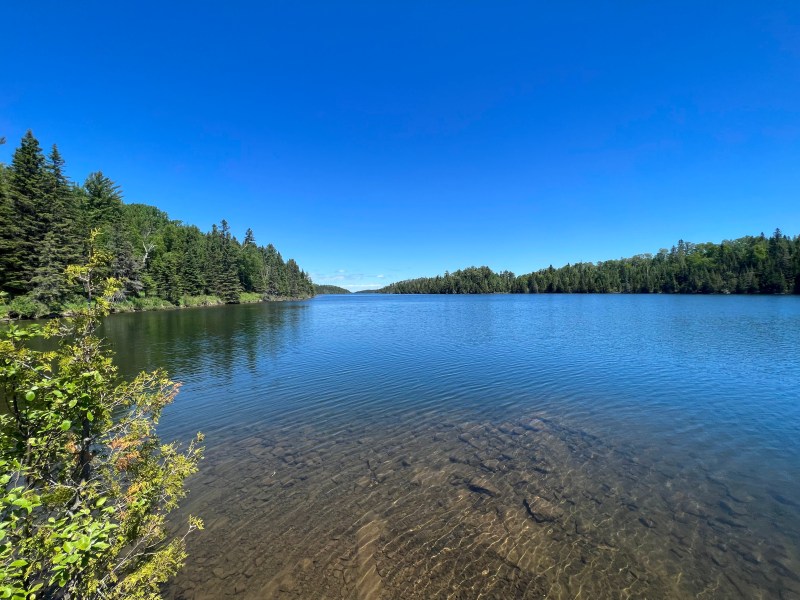
As we rolled into McCargoe just after noon, two things immediately stood out. The first was how picturesque it was, sitting at the base of a long inlet of placid blue water. While our campsite at Todd Harbor left little to be desired, I couldn’t help but feel a pang of jealousy as we passed the handful of wood huts and tent sites that looked over the cove. The second observation was how crowded it was. Now, on Isle Royale it only takes twelve people to constitute a crowd, but it still struck us as odd. We hadn’t seen a soul on the trail since Todd Harbor and it was still early for making camp. Additionally, many in the group seemed to lack gear that would suggest they were prepared for a night in the backcountry. Approximately 30 minutes later, the distant hum of an engine broke the silence of the cove and our questions about the group were answered. I had forgotten McCargoe Cove was one of the few ferry stops that provided day hikers and campers alike access to the west side of the island. As the Voyageur II arrived, we watched the group pack up and chatted with some rangers while preparing lunch. We were hoping for tips on where to find the bizarre bleeding tooth fungus, but sadly learned our odds were low around this part of the island. Eventually the ferry departed the way she came, and we were alone on the dock until a moose appeared on the opposite side of the cove, wading into the water to graze on some aquatic plants.

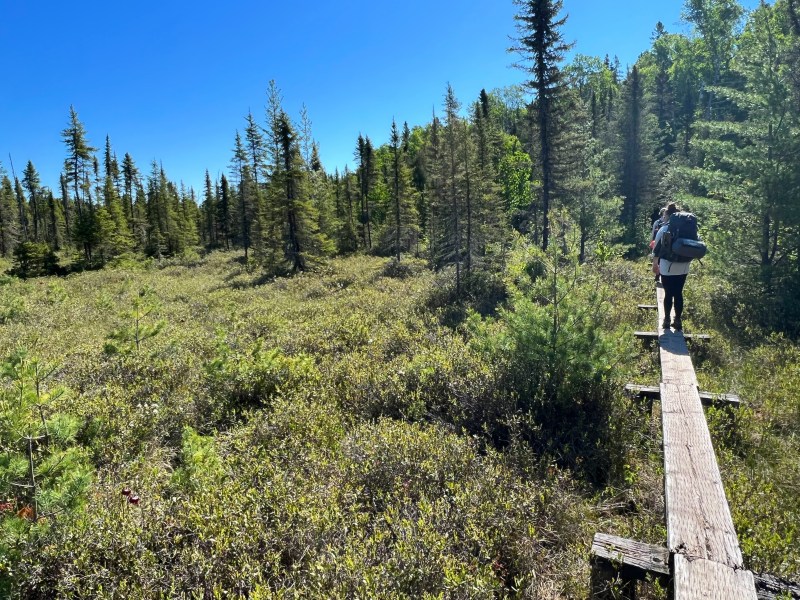
The hours ticked by as we sat near the McCargoe dock with the quiet confidence of backpackers who have just a few miles to go and plenty of daylight. Eventually, Chickenbone Lake beckoned and we resumed our journey by following the general path of our friend, the aquatic moose, who had disappeared into a nearby swamp. In a short while, the trail turned muddy and we soon found that several of the logs or boardwalks but it place by the park service had been submerged. It seemed the beaver dams that dotted the area were changing the landscape faster than the rangers could keep up. Fortunately, we had acquired a level of surefootedness from all of our earlier dam crossings and the muddy intersections no longer posed such a severe obstacle.

During what was probably our third successive dam crossing, a movement in the nearby water caught my eye and forced me to do a double take. Swimming in the little pond he had created was a beaver! Growing up in the Pacific Northwest, I was very familiar with beaver dams and ponds, but in all my time hiking and exploring I had never seen one. I’d gradually reached the point that even though we had already passed probably 50 dams on the Minong, it never remotely occurred to me that we could be lucky enough to see one of the inhabitants. I was overjoyed and held up the group for at least 20 minutes watching until he disappeared below the surface for what appeared to be the last time. Perhaps a hundred yards beyond the dam, we spotted our second moose of the day, grazing in a nearby swamp, but if felt like such an insignificant sighting compared to the beaver.

Just before 4pm, we arrived at our campsite for the evening – East Chickenbone Lake. In spite of the name, the site was, to our dismay, pretty far from the actual lake. In need of water for the evening, we set up camp and then made the steep trek down to the lakeshore. There we filled all the containers we had with water and for the third consecutive night had a proper bath. The water access point itself was quite treacherous and involved stepping over a silty slime that coated the bottom of the lake. Ironically, I teased our friend Jordan, the last one in, about the biting fish and sea lampreys that would probably take a liking to our blistered feet only to find a leech between my toes as I stepped out.

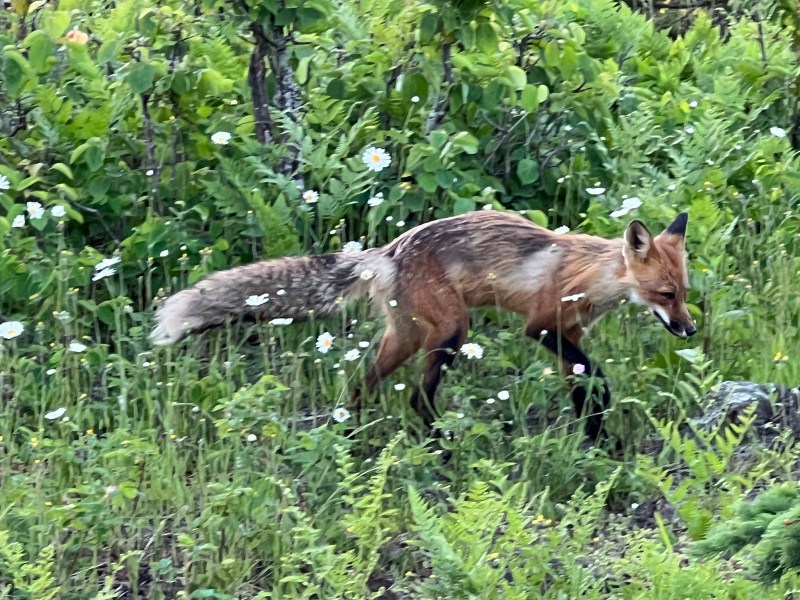
This was not the last strange occurrence of the evening. As we returned to camp exhausted and ready for bed, we drifted into some sort of wildlife witching hour. Soon, our camp was overrun with turtles who appeared to have climbed up the hill from a nearby swamp. Though they generally feared us, they made their way around camp poking around our tents and examining all of our gear. Then later, just as we were brushing our teeth and preparing to turn in, a gorgeous red fox ran right through the middle of our camp coming within a few feet of Emma as she stood frozen. It was so bizarre, the fox clearly saw and heard us but seemed to pay no mind as he went about his way.


Day Five: East Chickenbone Lake to Three Mile (10.3mi)

Our final full day in the backcountry got off to an uneventful, yet ceremonious, start as we packed up and descended the small hill that we had camped on the night before. At the bottom, within a few hundred yards of camp, we came to a fork in the road. Though we continued straight on through, this marked the technical end of the Minong Ridge trail, a bittersweet landmark despite the fact we still had a dozen miles to go. From this point forward, were officially walking on ‘The Greenstone,’ Isle Royale’s other famous cross-island trek.

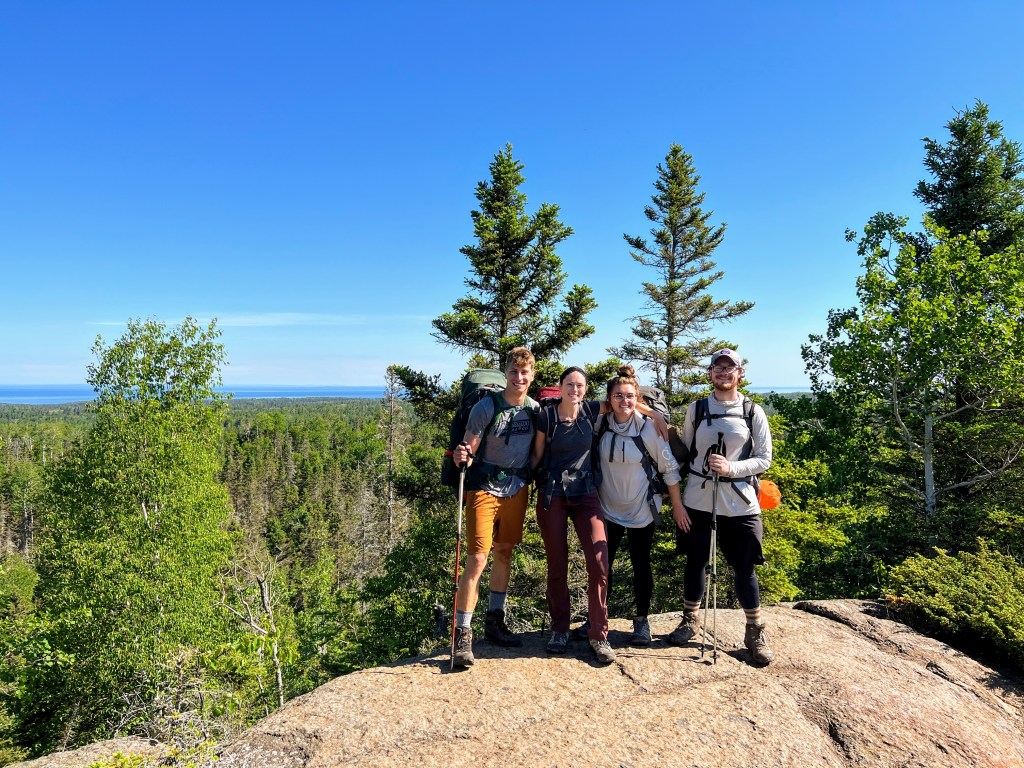
The day began with another climb onto a rolling ridge that, while still taxing on tired legs, paled in comparison to the steep grade and rough terrain that we had encountered on the Minong. Another thing we immediately found to be different as part of The Greenstone was the traffic. The route was by no means crowded, but within a mile or so of hiking we passed two other groups of backpackers who were undertaking a popular lollipop that loops around Moskey Basin and Lake Livermore. One of the parties consisted of a couple, coming in from West Chickenbone who we leapfrogged a couple times as our group would stop for water or to dig fruit snacks out the food bag. At a particularly scenic viewpoint not too far from Mount Ojibway, we crossed paths again and asked them to take our photo. Little did we know, that would be our last panoramic view from one of the Isle’s beloved ridges. Soon after, we reached another fork, took a right turn off the Greenstone, and descended towards the Daisy Farm campground, which was nestled right along the lakeshore.

There is always something so satisfying about finishing a long trek along a large body of water. It serves as the perfect finish line and as we pulled up to the Daisy Farm dock to look out over the lake, I could tell each of us was feeling that sense of catharsis. The thin crowd of people milling about the island’s largest campground only added to this effect. Though we still had miles ahead, we decided to soak it in and take a long break. We ate, read, slept, and poked around camp without the oppressive weight of our packs. By the time we moved on to make the short trip down the coast and past the lighthouse to Three Mile, we were feeling refreshed, ready for another fifty miles. When we rolled into camp and found no vacant sites, even that could not break our spirits. Eventually, we located a kind hiker who was only mildly annoyed to have to share his private beachside site with a group of backpackers. Later that evening someone in camp informed that a dead moose was decomposing near one of the other sites. The repugnant smell apparently resulting in a few closures and significantly reducing the capacity of the small camp.


Day Six: Three Mile to Rock Harbor (2.7mi)

Though only a couple miles stood between us and celebratory beers at the Rock Harbor Lodge, we decided to start our day at dawn in hopes of beating the rest of the Three Mile crowd to the premium sites. In spite of our best efforts, the plan was eventually foiled by a particularly slow-to-rise crowd around the Rock Harbor campground. Nonetheless, the rush out of camp proved well worth it as we had one of the busiest, most scenic stretches of the trail to ourselves.

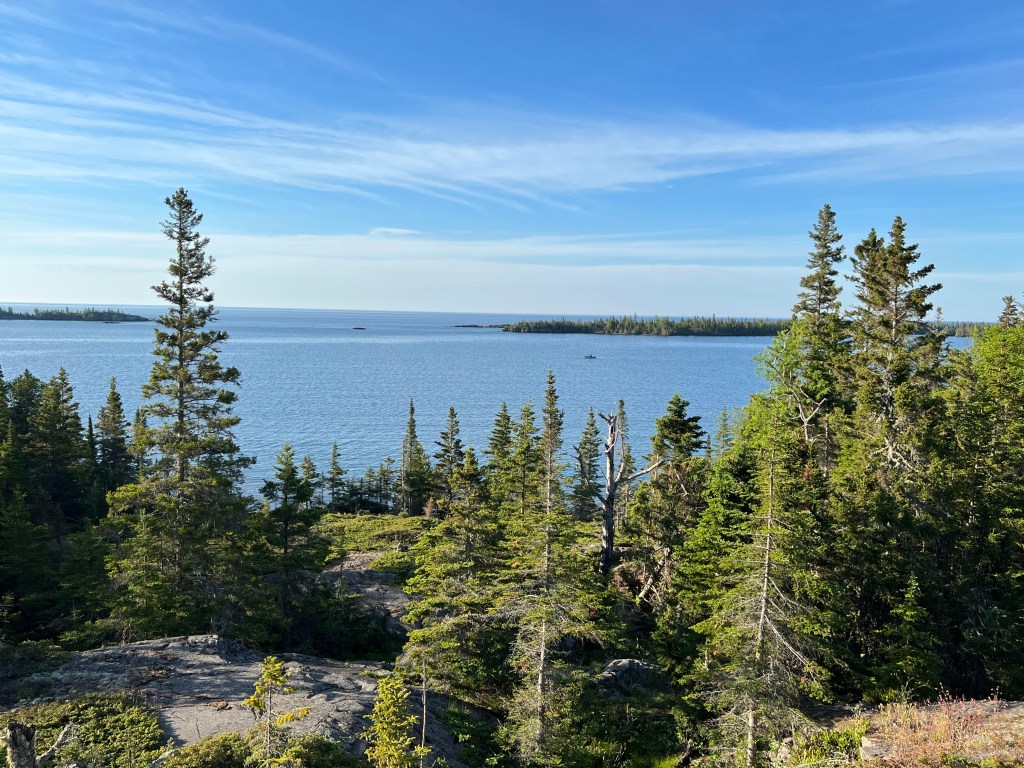
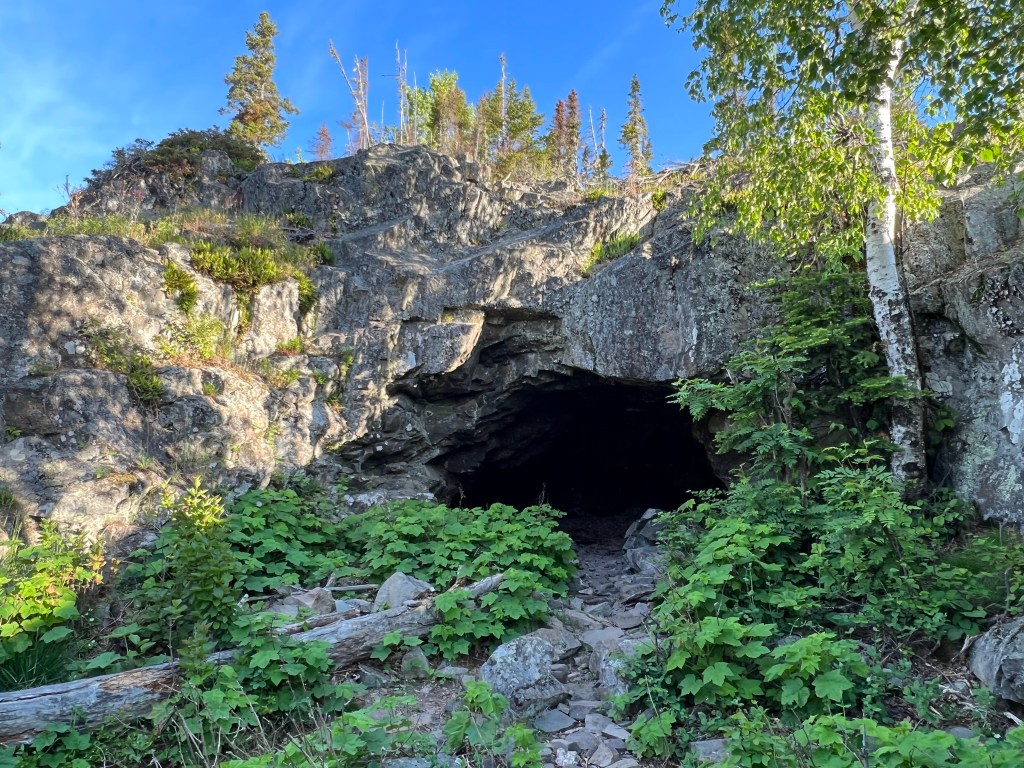
Embracing the calm, sleepy aura of the isle at dawn, we hiked largely in silence, accompanied by the sound of gentle waves lapping against the protected harbor. We didn’t stop until about halfway through our journey, when we took a short break at a trailside landmark known as Suzy’s Cave. As we polished off our supply of CLIF Bars and Welch’s fruit snacks (a personal favorite when hiking) for breakfast, I took a few minutes to poke around and do some extremely elementary spelunking. After clambering uphill to the mouth of the cave, I decided to crawl through to the other side of the shallow passage. There, I came upon a series of footpaths that led up the back side of the large rockface that the inland sea arch had been carved into. When I reached the top, I was faced with a magnificent view of Rock Harbor that seemed a fitting finale for a tough, but memorable, week. Just as I had finished soaking in some of my last moments on the trail and was prepared to head back down, a fox emerged from behind some bushes a few feet away. Upon recognizing my presence, he paused, calmly sat, and stared curiously forward. After a brief moment, he gave a short nod, as if to congratulate me on the completion of our journey, and subsequently disappeared down the hillside towards the rest of the group. It seemed a symbolic ending to an wonderful trip.

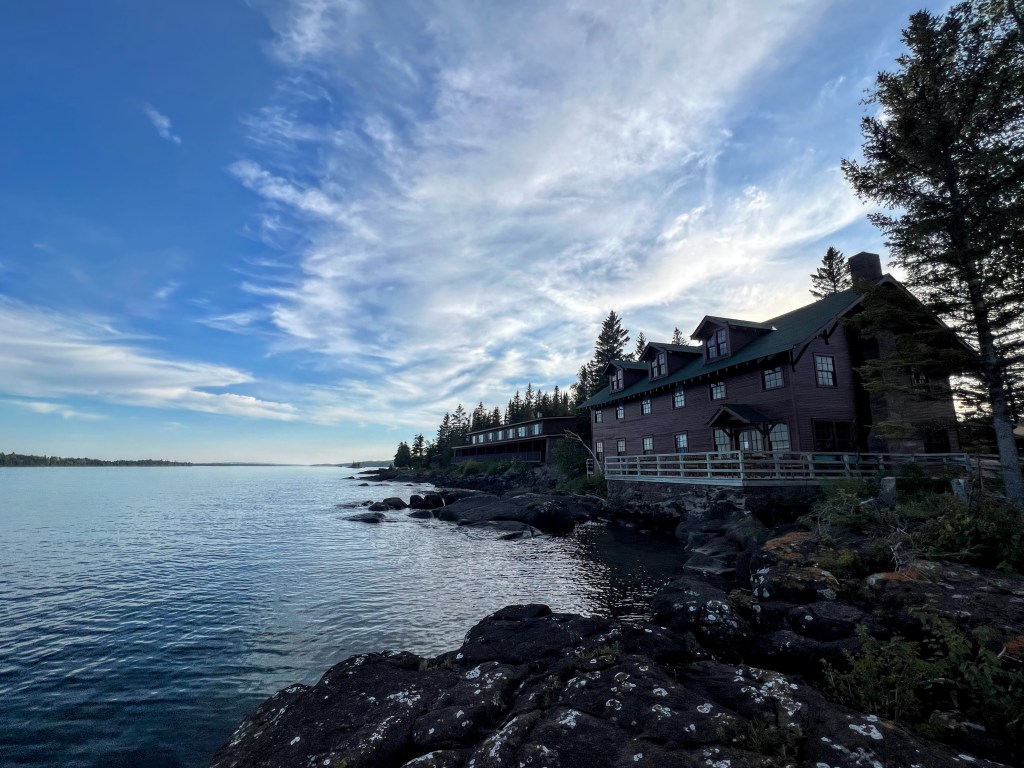
When we rolled into Rock Harbor an hour or so later, it was hard not to feel the excitement in the air. The small island “town” was a busy mix of recent arrivals and soon-to-be departures. Everyone was enthused about what they had experienced or were to experience on the island. After snagging our first wooden shelter of the trip, we made our way down towards the lodge with the whole day ahead of us. Deciding it was still too early for a pile of food and flight of beers, we elected to take another hike out to Scoville Point. It was rejuvenating to be moving around without the deadening weight of our packs and the hike turned out to be wonderful. Surprisingly, the wildlife on this end of the isle was quite active as well. Before finishing our little side quest, we had spotted nesting bald eagles, a family of sandhill cranes, and a mating pair of common loons.

With our hiking finally complete, we passed the remainder of our time on the island eating, drinking, and playing board games borrowed from the lodge. We made friends with several other groups of visitors, mostly visitors to the lodge who were generally eager to hear about what life was like on the Minong. Though we settled down for an early night’s sleep, we made plans for one last adventure: a 2:00am walkabout in search of the Northern Lights. Though the aurora ultimately eluded us, we did get a final thrill when we encountered a bull moose, no more than 10 meters away, in the pitch black.


Alternate Itineraries

There are a handful of side treks that you can do from the Minong Ridge Traverse and route modifications are encouraged. We added a sojourn to Huginnin Cove and found it to be our favorite campsite of the trip. Perhaps the most important logistical decision you will have to make in planning the Minong is whether to hike eastbound (Windigo –> Rock Harbor) as we did, or westbound (Rock Harbor –> Windigo), as most others do. This choice will have quite an impact on your overall experience, so to help, I have done my best to layout the advantages of each:

  • Northbound:
    • Allows you to get the hardest section out of the way first
    • Grants opportunity to finish with a burger and brews at the Rock Harbor Lodge
    • Ends in a part of the park with more day hikes and activities in case you finish early or with unused buffer days. This also comes in handy if you have the misfortune of facing flight / ferry delays or cancellations due to bad weather. These cancellations are uncommon, but not rare
  • Southbound:
    • Offers a more gradual ascent into the steeper section of the trail, best for those who would prefer to acclimate themselves with the rigors of backpacking
    • Allows you to finish strong with the hardest sections (pack will be lighter)
    • You can enjoy a more social experience with hikers headed your direction
    • Can lead to arrival at more crowded campsites earlier in the day (Three Mile, Daisy Farm)

Additional Sources

The Boy Scout Trail

The Boy Scout Trail

Joshua Tree Natl. Park, California

Length: 16mi. (25.7km.), with extensions 23.5mi. (37.8km.)
Days: 2
Difficulty: Easy (trails clear and elevation gain reasonable, but beware of extreme temperatures)
Gear: Standard gear + extra water (no source along route)
Completed: April 2022

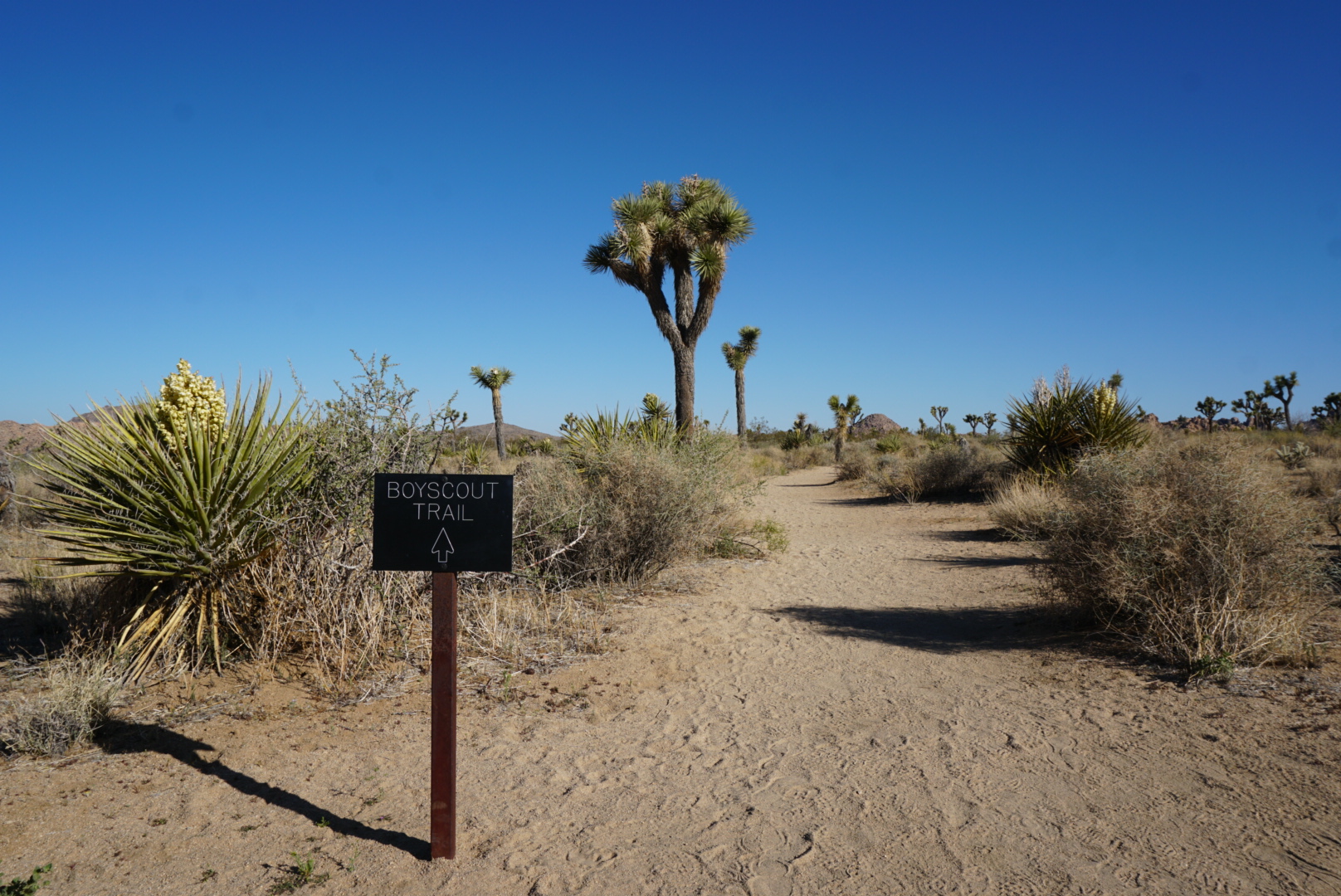
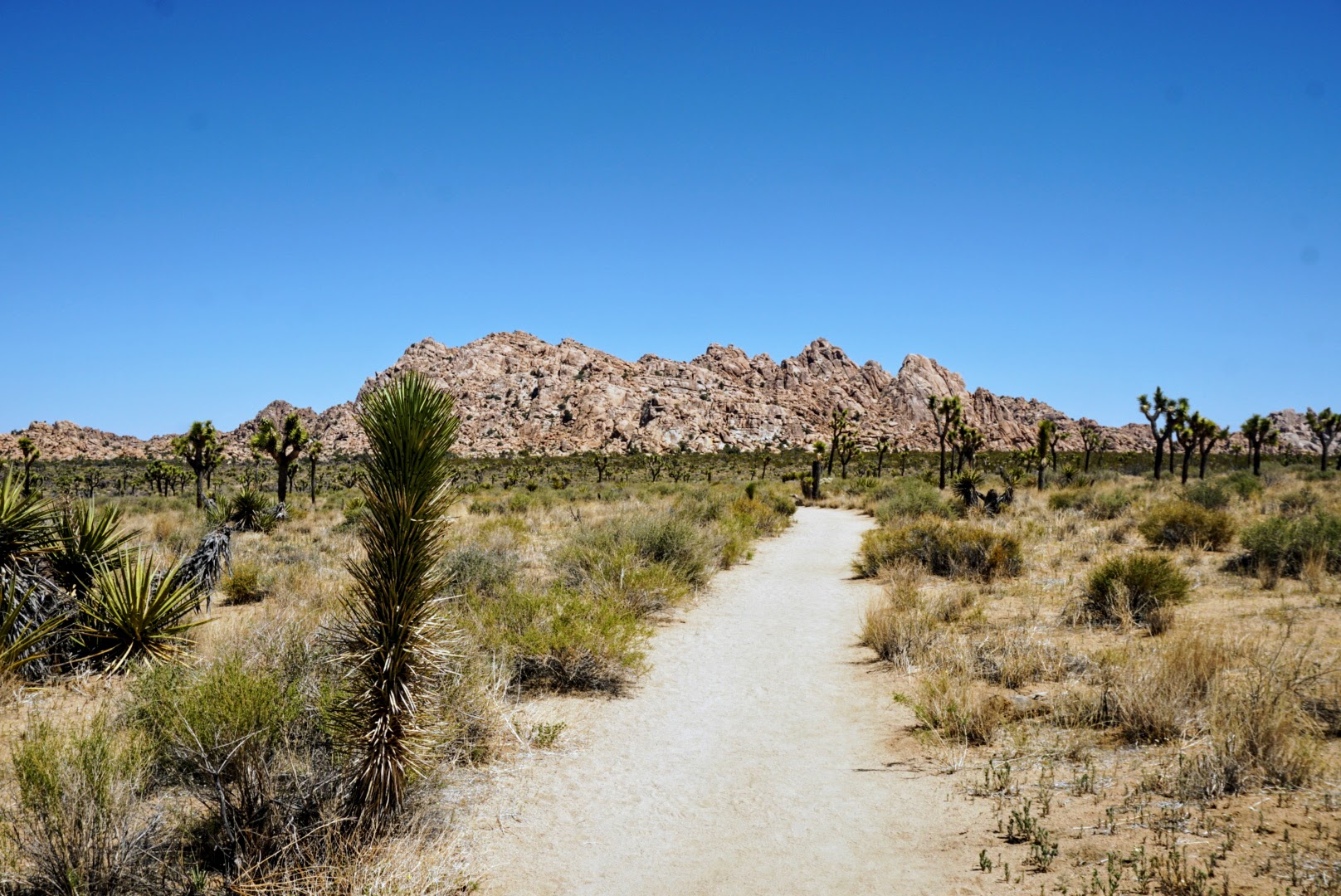
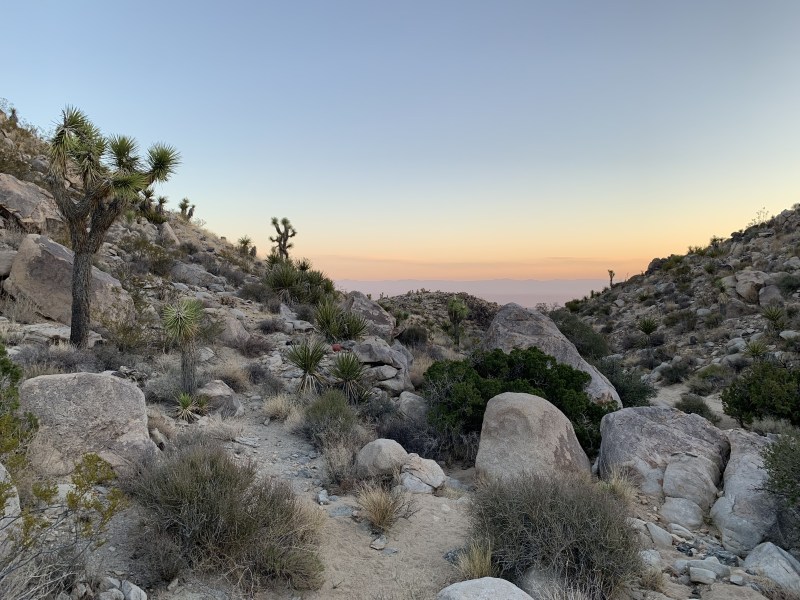
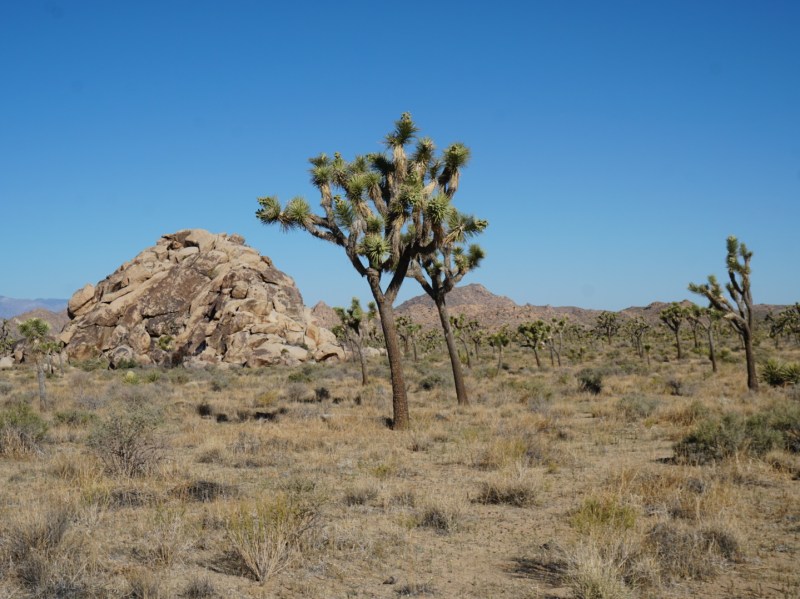
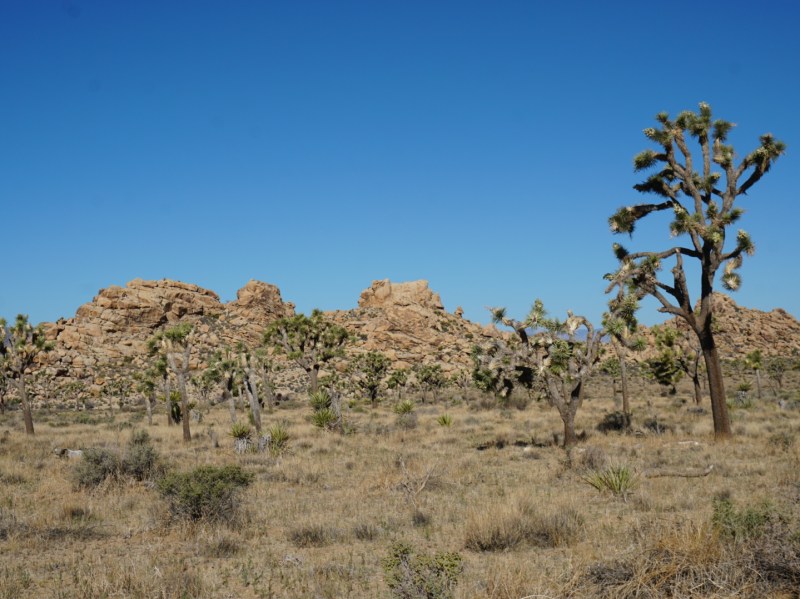
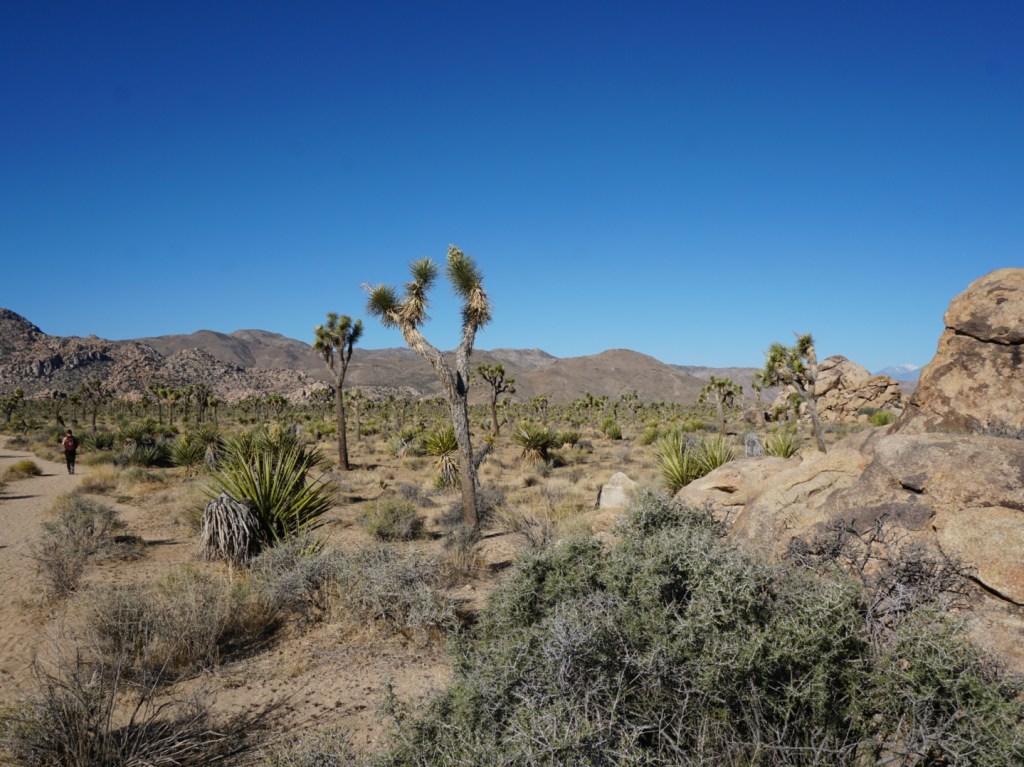
In summary: Due to its hot and rather unforgiving environment, Joshua Tree is not particularly known for backpacking. However, if you are determined and willing to take some extra precautions, most local experts would recommend fulfilling your sense of wanderlust on the Boy Scout Trail. An out-and-back trek that spans 8mi. each way, the Boy Scout Trail offers a look into the variety of landscapes that make up the Mojave portion of the park. Groves of the eponymous Joshua Tree dot the first portion of the hike, while the latter half serves up impressive mountain vistas and sunscapes. The possibility of spotting some elusive bighorn sheep or the rare desert tortoise only adds to the hike.


Preparation / Know Before You Go

Register before you hit the trail: Though permit availability does not limit the supply of backpackers in Joshua Tree, you are required to register for safety reasons. Your car is at risk of being searched / towed if you have not registered.

There is no water: There are no reliable water sources along the route, so it is critical that day hikers and backpackers alike bring extra water. To help us complete the journey without a cache, we packed food that did not need to be cooked or rehydrated.

Extreme heat is common: Keep an eye on the forecast and prepare for the extreme. There is practically no shade along the entire route and the park service recommends tourists avoid all long hikes when temps approach triple digits. For this reason, avoid the trail (and Joshua Tree altogether) in the summer months. Sunscreen and sunglasses are a must as the desert rock is reflective, only adding to the sun’s intensity.

Consider adding in some side hikes: The Boy Scout Trail itself is an 8 mile out-and-back, but a handful of side trails branch off from the main trail. Consider adding in some variety by including side routes like Willow Hole or the Big Pine trail.

Camp only in approved areas: Dispersed camping is allowed in Joshua Tree NP, but there are some areas that are off limits for conservation. Check before you go, but as of our trip, backpackers on the Boy Scout Trail were required to camp on the western side of the path.


Day One: Keys West Trailhead to Big Pine Trail via Indian Cove (16.5mi)

Sitting in the Keys West parking lot and arranging gear at 10:00am, the first thing we noticed was that it was already quite warm. By the time we finally ditched the car, lathered up with sunscreen, and hit the trail, the heat was even more intense. Despite planning a spring trip to Joshua Tree and being blessed with a cooler weekend, there was no escaping the Mojave sun. As a couple of Chicagoans on vacation however, we elected to embrace the warmth and spirits were high as desert sand replaced the parking lot beneath our feet.

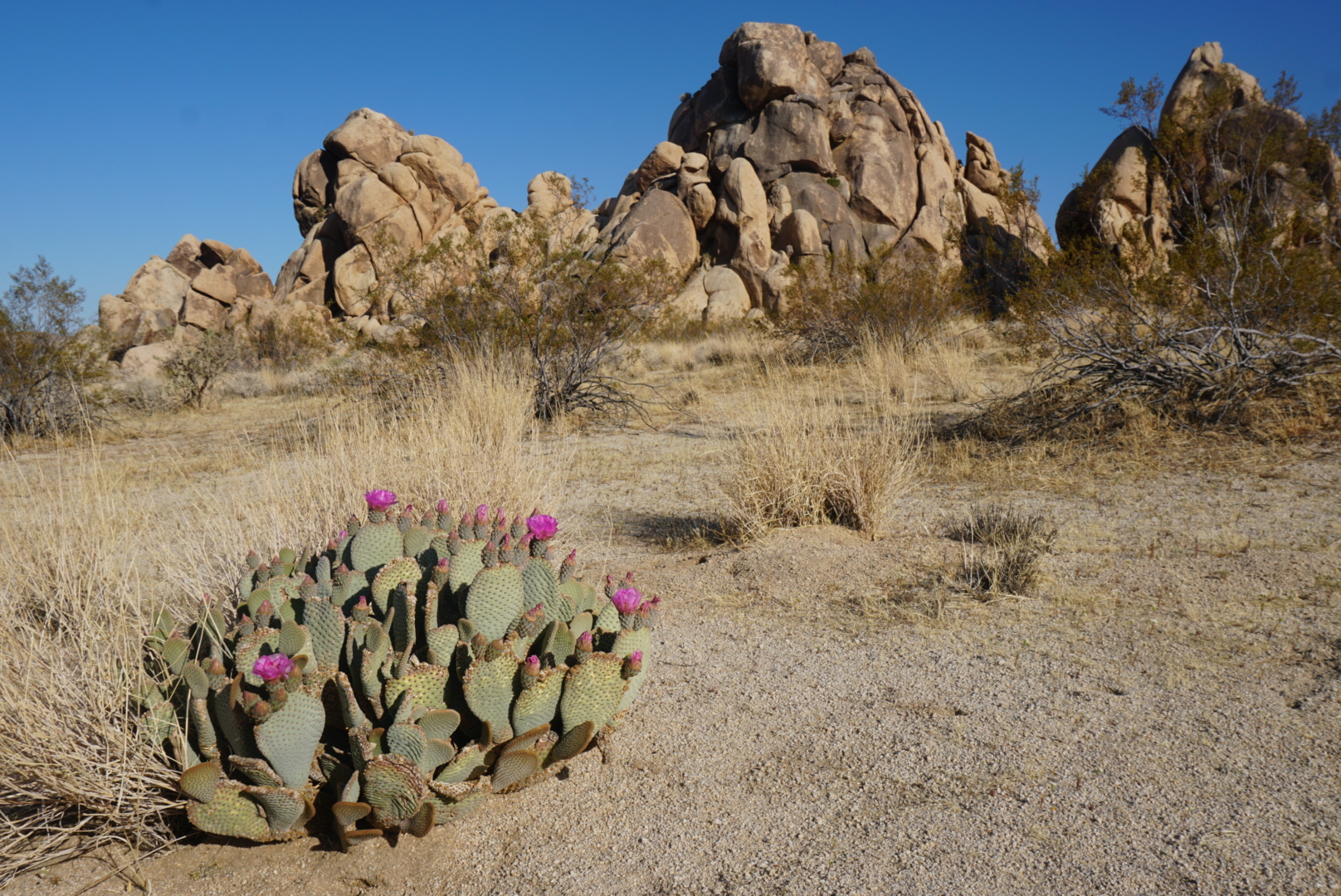
Accustomed to steeper terrain, Emma and I felt as if we were flying over the gentle grades around Keys West. This, combined with fresh legs and a sense of wonder from walking amongst the Joshua Trees, yucca, and prickly pear propelled us to an early arrival at the Willow Hole junction. Impressed with how quickly we were covering ground, we disregarded our late start and decided to take the well-regarded detour towards Willow Hole. A hard right turn steered our course away from the endless flat path across the Mojave and toward the low ridges that dotted the horizon.

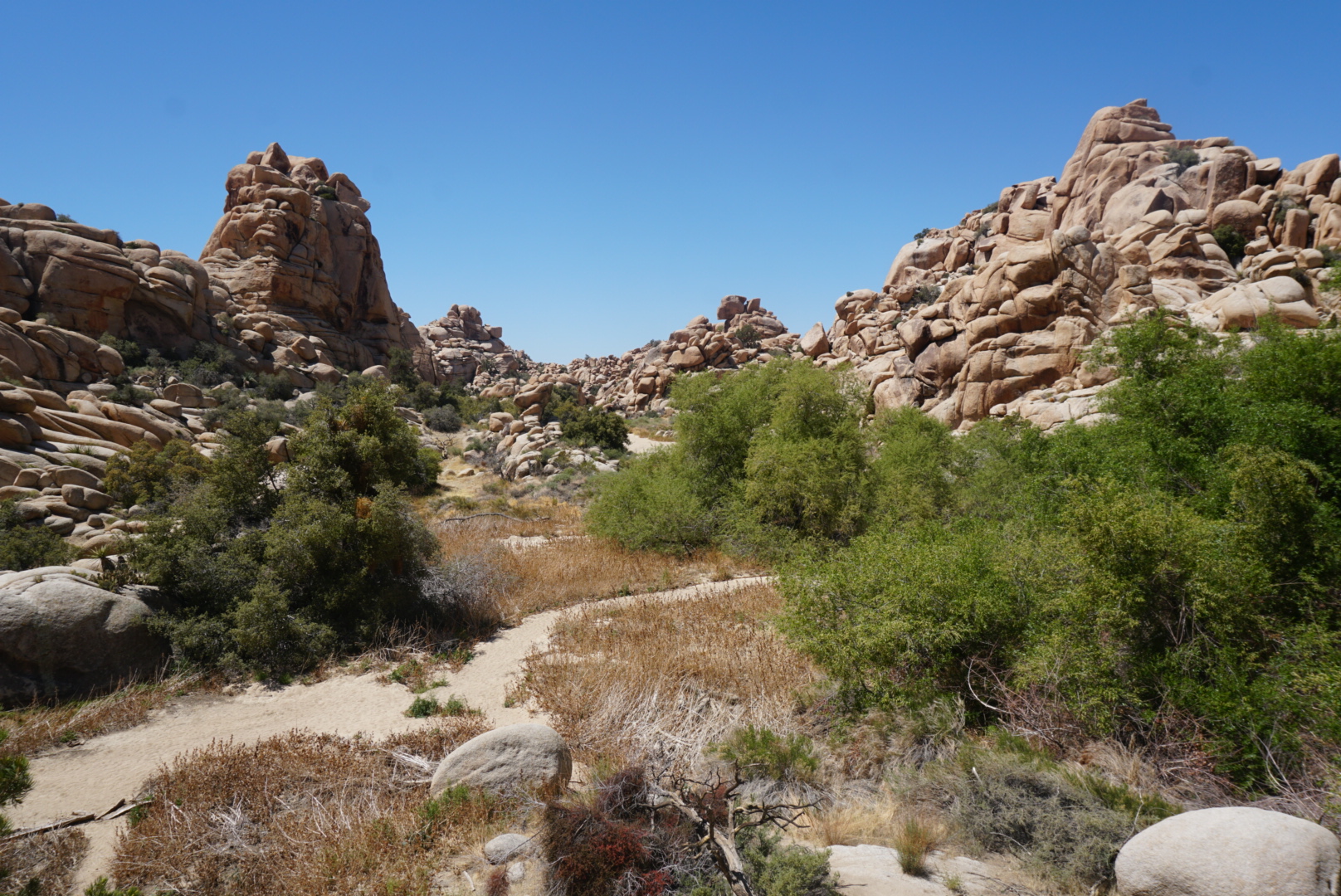
In no time, the trail brought us to a dried-up wash that steadily meandered its way through an opening in the rocky outcroppings. As the sand got finer beneath our feet, the ridges got higher on either side until we were surrounded by what would probably classify as a miniature mountain range. We’d later learn this area was called the “Wonderland of Rocks”. Just as we were discussing how it would be the perfect place to learn to boulder, a couple of dirty guys appeared with crash pads strapped to their backs and waved hello. About a half mile later, we came across a conspicuously green thicket of desert willows, indicating the trail’s terminus. Almost certain that the dense stand of trees was concealing an oasis, we charged ahead until we came out on the other side. Quiet and scenic, we chose this secluded spot to stop for a quick lunch break.

After lunch we did a little exploring, performing our best Bighorn Sheep impressions on the smooth rock. Once tired of climbing around, we retraced our steps all the way back to the junction. By this time, we were in the heat of the day and starting to sunburn despite the frequent re-application of sunscreen. As we walked, I realized my immense gratitude for both the flat terrain and my strategic decision a week prior to trade my man-bun in for a short fade. The flat path through the dispersed forest of Joshua Trees continued for a little over four miles, at which point, the outcroppings began to reappear.

Just like at Willow Hole, a wash emerged as we approached the rocks and gradually the outcroppings grew into mountains even larger than before. Soon we would find ourselves descending from the high plateau via a narrow canyon. The descent offered some impressive views of the distant Copper and Bullion mountains, and even more importantly it provided some occasional shade. After an hour of hiking and a few water breaks, we reached Indian Cove at the base of the mountain range. Here we were faced with a flat, barren valley dominated by dirt, prickly pear, and desert scrub. The remaining hike to the trailhead was unremarkable, especially since we knew we were turning right back around. Determined not to cheat the mileage however, we continued the whole way.

By the time we reached the trailhead, the sun was starting to get low. An anxious sense of urgency started to set in as we were still miles from where we intended to stop for the night. Quickly, we hopped back on the trail and into the mountains, following the Boy Scout all the way to its junction with the Big Pine Trail. At this point daylight was nearly gone, but the idea of covering some new ground beyond the Boy Scout was tempting. In the end, curiosity won the day and we took the detour, hiking another mile or so until it was too dark to continue. There was no shortage of flat, sandy ground, so after pitching the tent and devouring a dinner of packaged tuna, we settled into a comfortable sleep.


Day Two: Big Pine Trail to Keys West Trailhead (7.0mi)

At 2am, the jarring sound of a phone alarm signaled the beginning of our second day out on the Boy Scout Trail. Though we planned to get an early start, the purpose of the alarm was not to hike, but rather a reminder to check for stars. While alarms aren’t usually a necessity given the quality of sleep one gets on a thin camping mat, Joshua Tree was an International Dark Sky Park and after our experience in overnighting in Canyonlands we didn’t want to risk missing the display.

As the brain fog cleared and I was able to take stock of our surroundings, I was stunned. There were few stars, but the mountain range we were sleeping in was completely illuminated by an eerie glow. Without taking hardly any time for my eyes to adjust, I could see seemingly for miles from the threshold of my tent. Directly above, a new moon hung, casting a shadow-less radiance across the range. It felt as if I were looking through a telescope, the texture and impressions on the moon were clearly visible to the naked eye. Though it was far from what was expected, the alarm had proven to be well worth it, even if the concentrated moonlight made falling back asleep quite difficult.

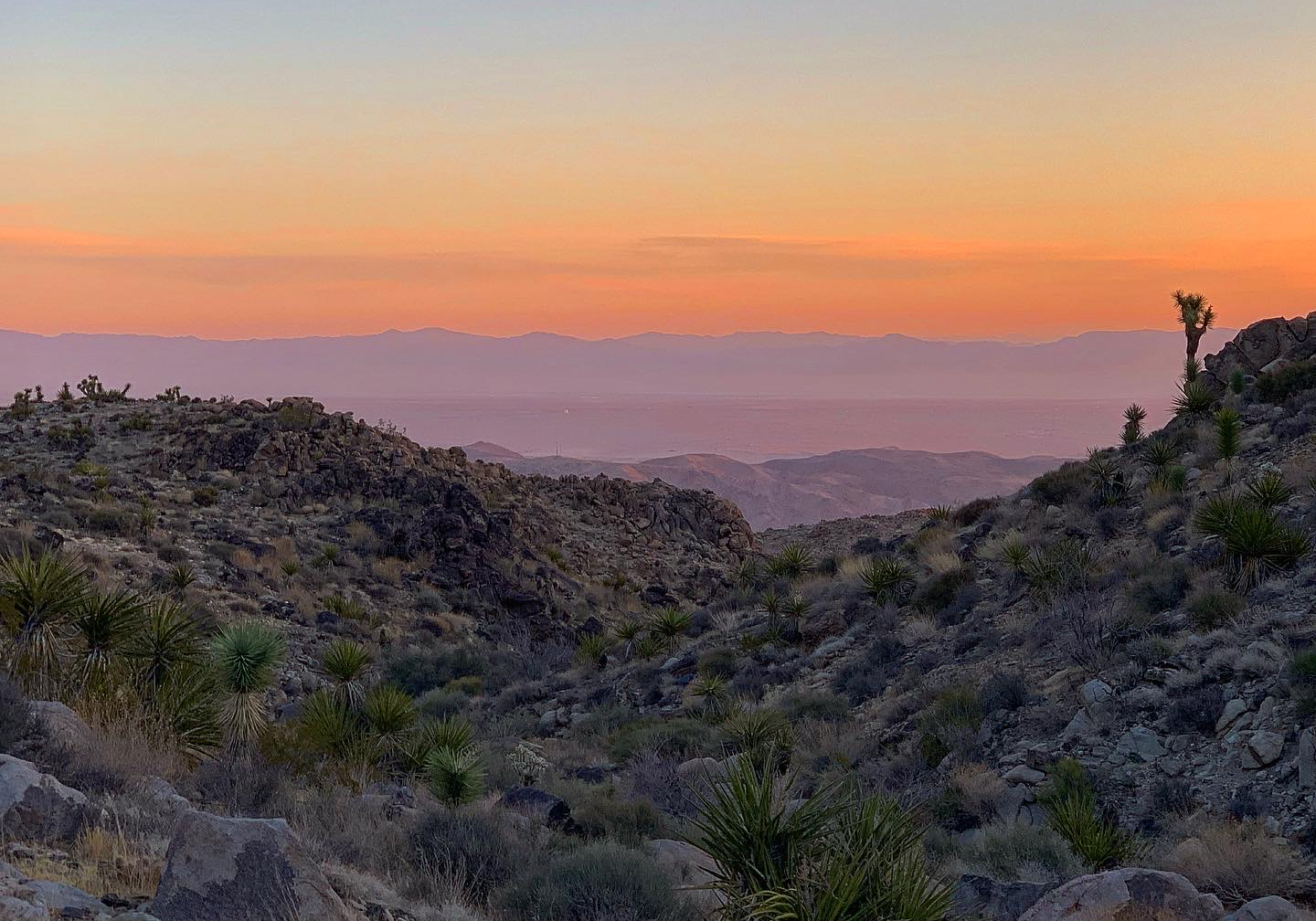
Just a few hours after dozing off for the second time, we woke again. This time the sky was painted by a soft violet hue by the pre-dawn sun. Estimating that we were only a few tenths of a mile from the end of the Big Pine, we decided to hike the last bit without bringing packs or deconstructing camp. We figured the more arduous tasks could be saved until the sun was up and our blood was flowing. Sure enough, we reached the end of the trail within fifteen minutes. It was marked by a low, green pine that stood out against the brown and grey palettes of high desert rock. Just past the pine was a wide gulley that led to a view of the distant mountains and the valley of Twentynine Palms. At any other time of day, the vista would have resembled those we had seen the day prior. However, at the crack of dawn, it revealed a colorful sunrise that justified waking up for it. After enjoying the peaceful scene for a few minutes, we made our way back to camp, packed up our gear, and once again began following that narrow path across the wilderness.

Gradually, as if carried away by the cool morning breeze, our remaining mileage began to dwindle. Preoccupied by the sights and sound of a Mojave morning, we hardly spoke as made our way back towards the car. As advised, we kept a keen eye and ear out for the sign of a Bighorn Sheep or rare desert tortoise. We had been told they were most active during the mornings, but aside from the birds returning to the yucca and a lone black-tailed jackrabbit, the desert was still. No later than 24 hours after we had arrived the day prior, we found ourselves strolling back into the Keys West parking lot. After providing a quick trail report to those about to embark on their own adventure, we climbed back into the car and were off in search of a cold drink and much-needed shower.


Alternative Route

While we thoroughly enjoyed our experience on the Boy Scout Trail and were able to add in some variety with the Willow Hole and Big Pine extensions, I am a strong believer that loops or lollipop hikes are always preferable to an out-and-back. Unfortunately, it was not until after our adventure that I learned of an alternative route that can be created by stitching the Boy Scout Trail together with some of the other nearby trails.

If you only have one vehicle and want to avoid retracing your own steps, I would strongly consider testing out the following 14.2 mile route. It can be completed in either direction. The route does involve small sections of road walking and skips over the Indian Cove portion of the Boy Scout Trail, but in my opinion that was the least impressive section of our trek.

Sample itinerary:

  • Start: Keys West Parking Lot –> Big Pine Trail (still consider the Willow Hole extension)
  • Big Pine Trail –> Maze Loop Trailhead
  • Maze Loop Trailhead –> Bigfoot Trail
  • Bigfoot Trail –> Quail Springs Historical Trail
  • Quail Springs Historic Trail –> Quail Springs Recreation Area
  • End: Quail Springs Recreation –> Keys West Parking Lot (via road)

More details about the route can be found on its AllTrails page at this link.


Additional Sources

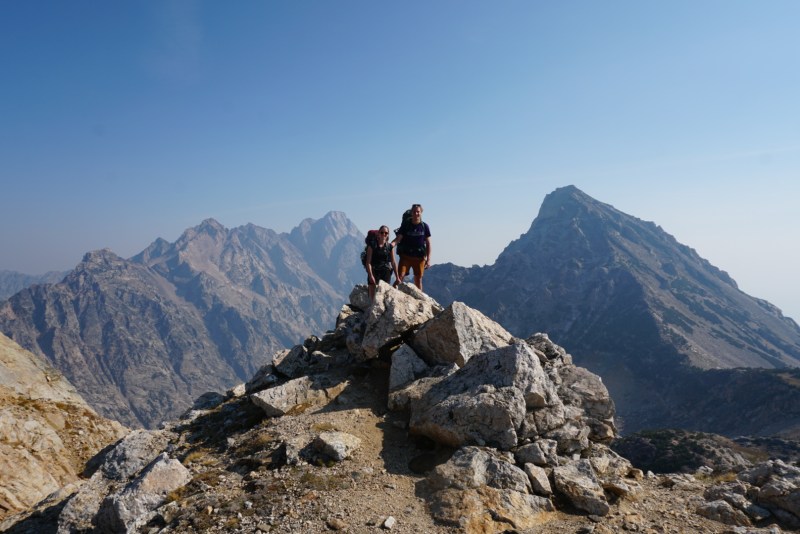
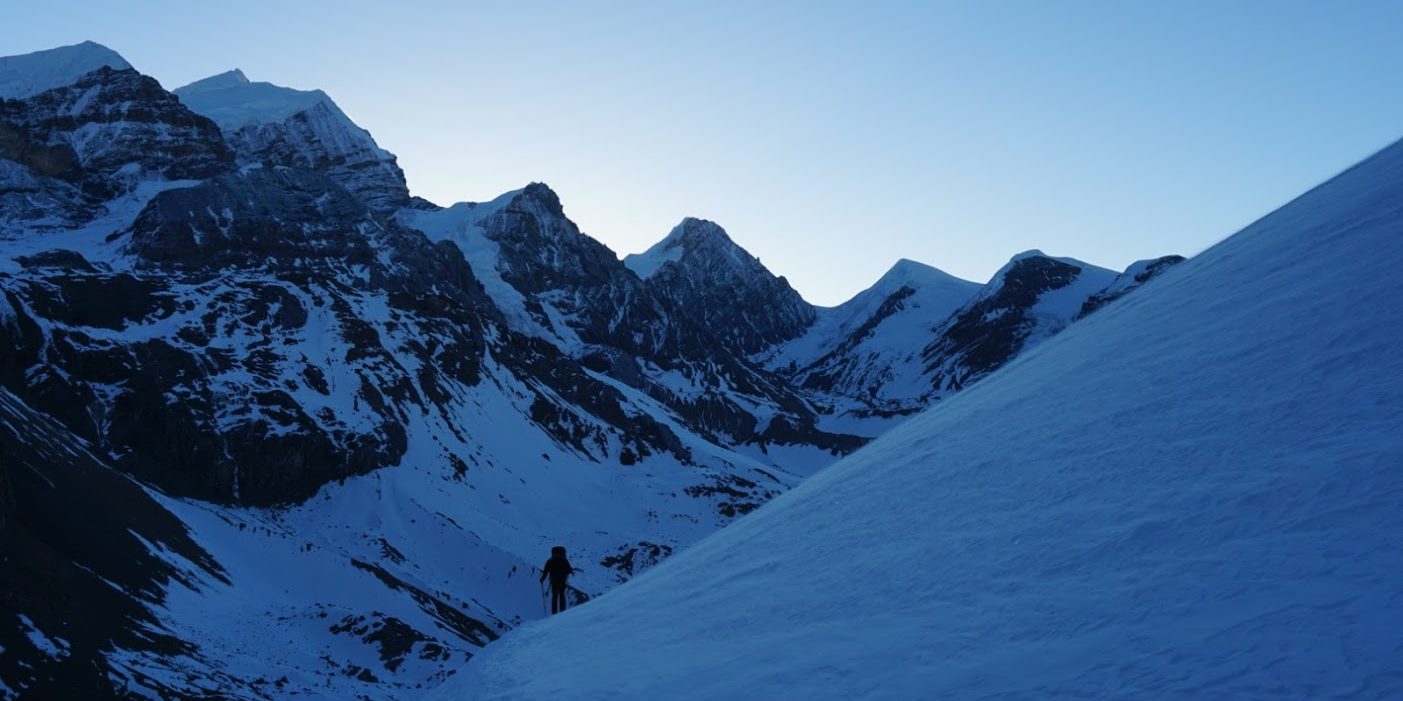
Teton Crest Trail

Teton Crest Trail

Grand Teton National Park, Wyoming

Length: 40.3mi (64.9km)
Days: 3-4
Difficulty:
Hard (no facilities, elevation change, rough terrain, and wildlife)
Gear: Standard + bear canisters (GPS/PLB recommended)
Completed: September 2021

In summary: Perhaps the best of the great American backpacking trips I have been on, the Teton Crest Trail is a route that all serious hikers should have at the very top of their travel bucket list. Make no mistake about it, the journey is difficult. Over the course of over 40 miles hikers must brave steep, rugged terrain, wildlife, and the potential for inclement weather. Still, the best things come to those who work for them, and the payoff of the Teton Crest is unparalleled. We turned every corner and topped every hill with a heightened sense of anticipation, never sure when we would be faced with a moose, bear, pristine alpine lake, or stunning mountain vista. There is no better way to explore the beautiful Grand Teton National Park than hiking the remote Teton Crest Trail.


Preparation / Know Before You Go

Grab your permit early: Backcountry campsites are in high demand within Grand Teton National Park (GTNP), so it is important to register for a permit early and build a little extra slack into your travel plans should your route need to be modified. This is especially important on the Teton Crest, as it is the park’s most renowned long-distance route. There are two methods for securing a GTNP backcountry permit:

  1. Book an “advance permit” during the online registration period which usually opens for the coming year in early January. This requires you to know your dates and place a non-refundable deposit. One-third of backcountry sites will be booked this way.
  2. Book a “first-come first-serve permit” either the day of, or day prior to, your intended reservation. This is how the remaining two-thirds of sites are filled. Be forewarned that the lines for these permits form early at the visitor centers, and one should arrive early to ensure first pick of the available sites. We arrived at 6am sharp and were already the second group in line. By the time are visitor center opened, there were roughly 10 parties waiting.

Plan for a wildlife encounter: The Teton Crest is one of the best trails in North America for spotting big game wildlife up close and personal. This can be a highlight of the trip, but only if one is prepared. Bear canisters are required and spray is highly, highly recommended for every member of your party. Wolves, mountain lions, bison, moose, and elk are all present in the park. Be sure to keep your distance from the herbivores as well as the carnivores; all can be quite ornery (especially during the rut) and have caused loads of problems for naïve photographers who get too close.

Rent, don’t buy, essential gear: Bear bins and bear spray are necessary when camping in the Tetons (see above), but visitors to the park can save a lot of money renting gear locally rather than buying themselves. Hard-sided food canisters are best obtained at visitor centers within the park, while spray can be rented from the nearby Jackson Hole Airport or a number of outdoor proprietors in town.

Prepare for inclement weather: While we were blessed with clear skies on our journey, snow or thunderstorms are quite common in the region and hikers should be prepared for the worst. Snow is most common towards the beginning or end of the peak season (July – September), while thunderstorms can occur all summer. High heat is another possibility that hikers should take precautions against.

Crampons may be required: Check with a ranger to see if crampons or an ice ax may be required. Some of the steep passes may be covered in snow, especially if walking during the spring season.

Marmot-proof your campsite: Marmots are everywhere along the Teton Crest, and while fun companions during the day, they turn into destructive bastards at night. Consider hanging or tenting gear to keep it safe. We ran into a fellow traveler who had his shirt eaten overnight, and on our last evening one tried to make off with my hiking pole. Fortunately, it gave up on the heavy object, but not before taking a few bites out of the rubber grips.


Day One: Phillip’s Bench Trailhead to Middle Fork Granite Canyon (8.8mi)

The magic of the Teton Crest is that there truly is never a dull moment in the trail. Over the course of four days and 40 tough miles we never found a bad view or lost the sense of wonder that comes with the ever-present possibility of an animal encounter. From the moment we stepped onto the trail at the inconspicuous roadside pullout, we felt lost in the vast Wyoming wilderness.

Though we planned to get an earlier start to our adventure, the logistics of securing a permit, renting bear spray, and commuting to the trailhead gradually compounded into an afternoon start. The sun was shining and skies were clear however, so nothing could dampen our spirits. The first few miles near Phillip’s Bench were a fantastic warmup. We were far from the throngs of summer tourists moving in and out of the visitor center, but nonetheless we found the trail quite social. We pet a few cute dogs and made conversation with day hikers and locals exploring the more accessible parts of the park. Everyone seemed excited for us, and the few who had experienced the Crest told us we had some great hiking in store. As we continued on, we gradually moved between clumps of high density forest and wide open mountain meadows. The wildflowers had come and gone without us, but the colorful brush left behind painted splotches of maroon, lavender, and white across the rolling hills.

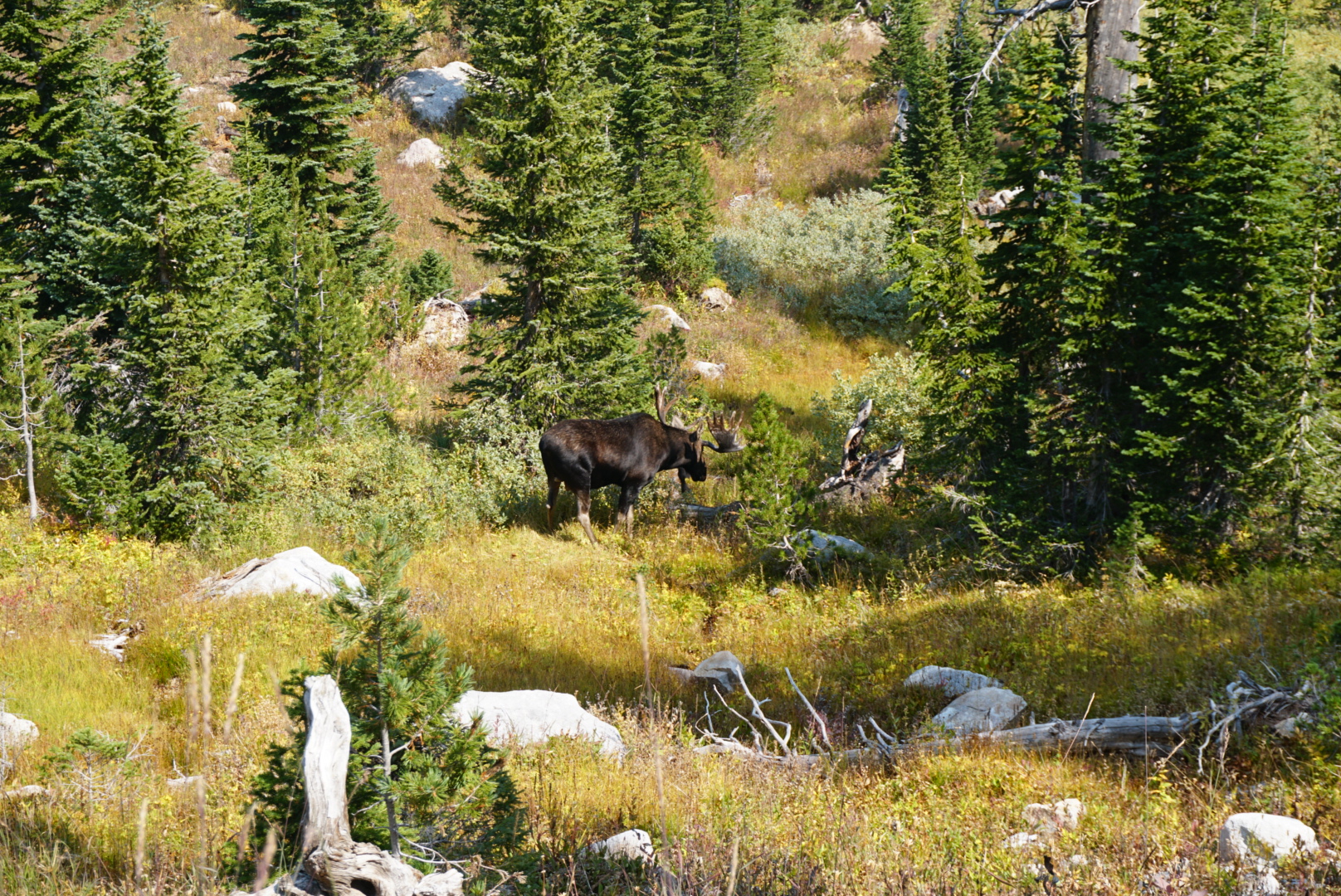
After some gradual climbing, we reached Phillip’s Pass, at which point were ceremoniously left the civilized world behind and stepped onto the official Teton Crest Trail. We had reached the Teton backcountry and pushed into it, thrilled to be crossing a major milestone off the outdoor bucket list. No more than 200 yards from this milestone, our joy was transformed into a moment of pure terror. The ensuing trail had led us into a small thicket of trees, where a downed log posed as a bit of an obstacle. As I began to clamber over the old trunk, I saw a from the corner of my eye a massive movement. I knew it could only be one of two things, and either way, we were far too close. As I snapped to look, I found myself face to face with a fully-grown bull moose. It was in the trees roughly 10 yards away, and had stopped grazing just to size up the two bipeds that were obliviously encroaching on its personal space. “Emma, MOOSE!” I whispered as loudly as I could. We stood frozen for what felt like an eternity, until our hearts started beating again and we found the composure to slowly sidestep the log, giving the moose a much wider berth.

Once clear, an overwhelming sense of euphoria crowded out fear. We could not believe what we had just witnessed. Though we had begun our journey hoping for a moose sighting, this was a bona fide encounter. Better yet, we had had a story to tell that did not involve being curb-stomped. The remainder of the day was a relative blur. A heavy dose of adrenaline propelled us up and down some intense grades, along the edges of beautiful canyons, and around Rendezvous Mountain. Despite our intense focus on the potential presence of big game, we made a deliberate effort to soak in the magnificent scenery around us. Perhaps a few hours before dusk, we rolled into Middle Fork Canyon and made camp not far from a calm mountain stream where we ate dinner and quietly watched a set of grazing mule deer.


Day Two: Middle Fork Granite Canyon to Alaska Basin (9.8mi)

We woke early on day two of our adventure ready to get a move on. It had been a silent, warm night, and the relative heat combined with a discomforting sense of “bearanoia” made for light sleep. Nonetheless, the calm morning hinted of another beautiful day and after a quick oatmeal breakfast we were back on the trail. We began with a quick climb out of our protected canyon and over another saddle. At its core, the Teton Crest is navigating a series of remote canyons and the steep mountain passes that divide them. Upon reaching the terminus of Granite Canyon, we began a steep, scree-covered descent towards Marion Lake. As we worked around the rockfalls, we could were greeted by the shrill pips of nearby pika and marmots wary of our presence. Still, we never saw more than a flash of fur as they dove into crevices out of our sightline.

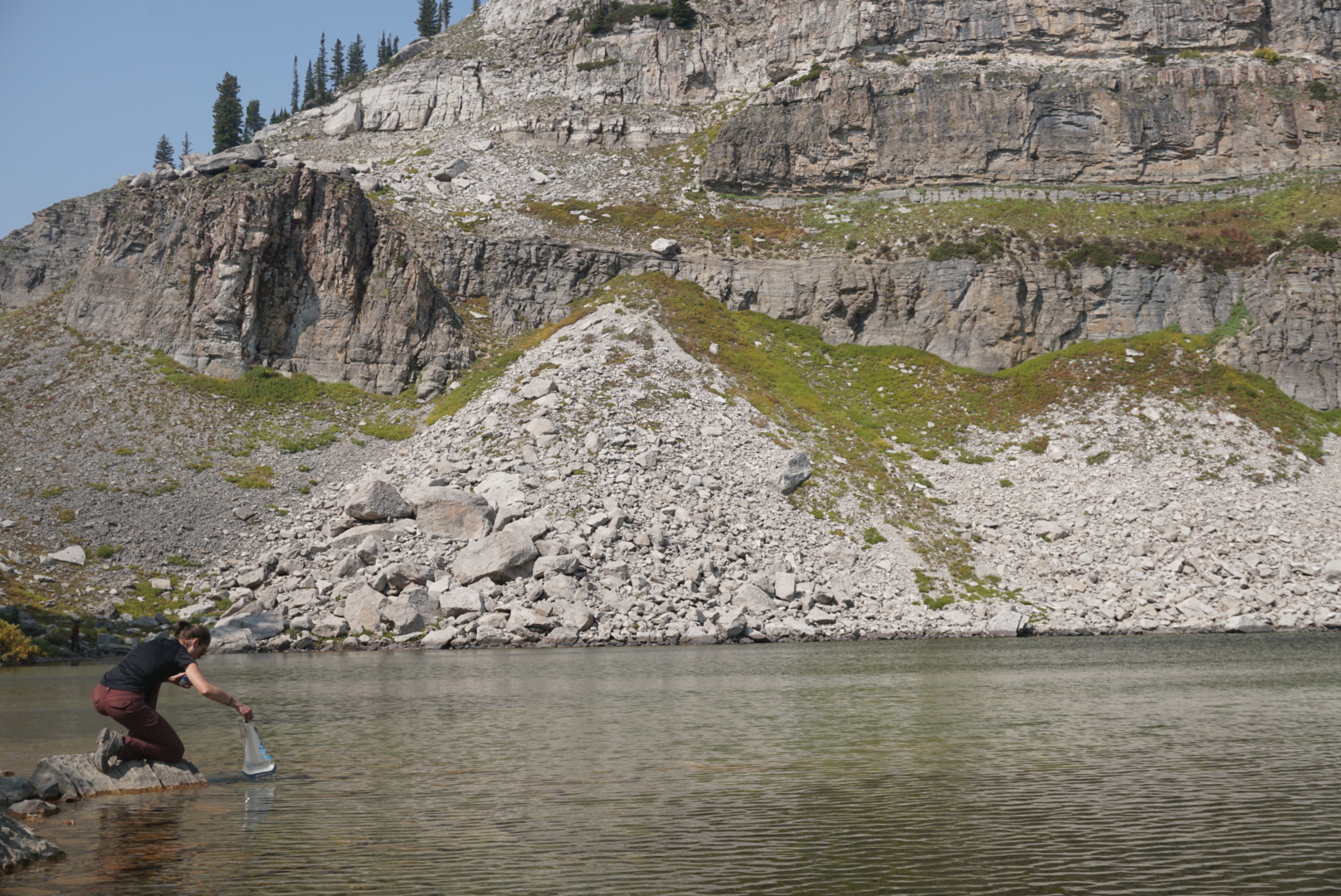
At Marion Lake, we paused for our first break of the day. It was early and our legs were still fresh, but we agreed the scenery at the crystal clear lake was too good not to enjoy. We fancied a swim, but fear of chafe and a desire to wait until the heat of the day convinced us otherwise. Had we started a little earlier the day prior (or secured the right permit), I would have loved to have camped there. Following the lake, we made yet another climb, this time to Fox Creek Pass along the border of the national park and the Jedediah Smith Wilderness. There we stood underneath the prominent Fossil Mountain, which we had mistaken as part of the Teton Range the day prior. Our map indicated that there were some caves not too far away, but sadly we didn’t have the extra time to explore.
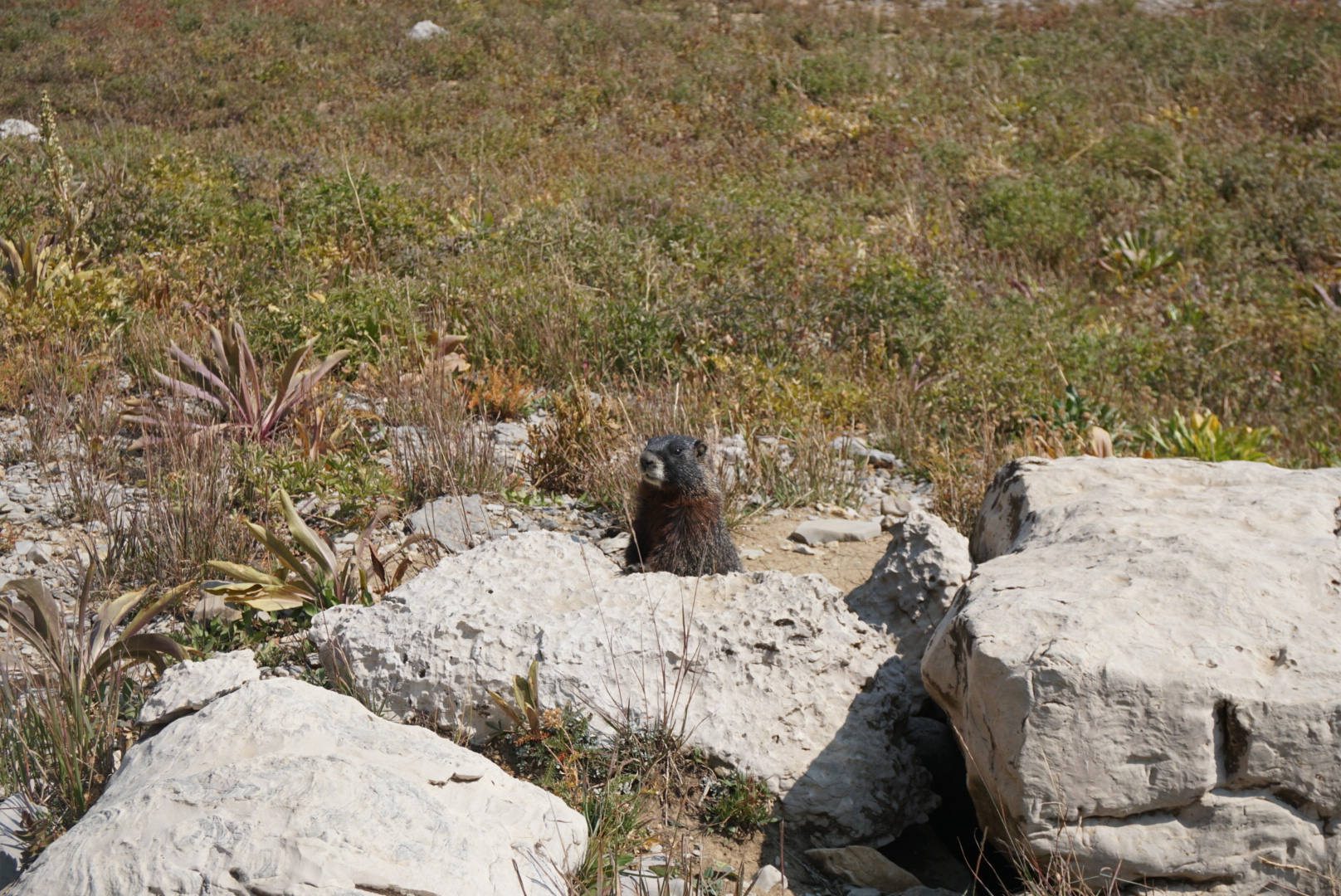
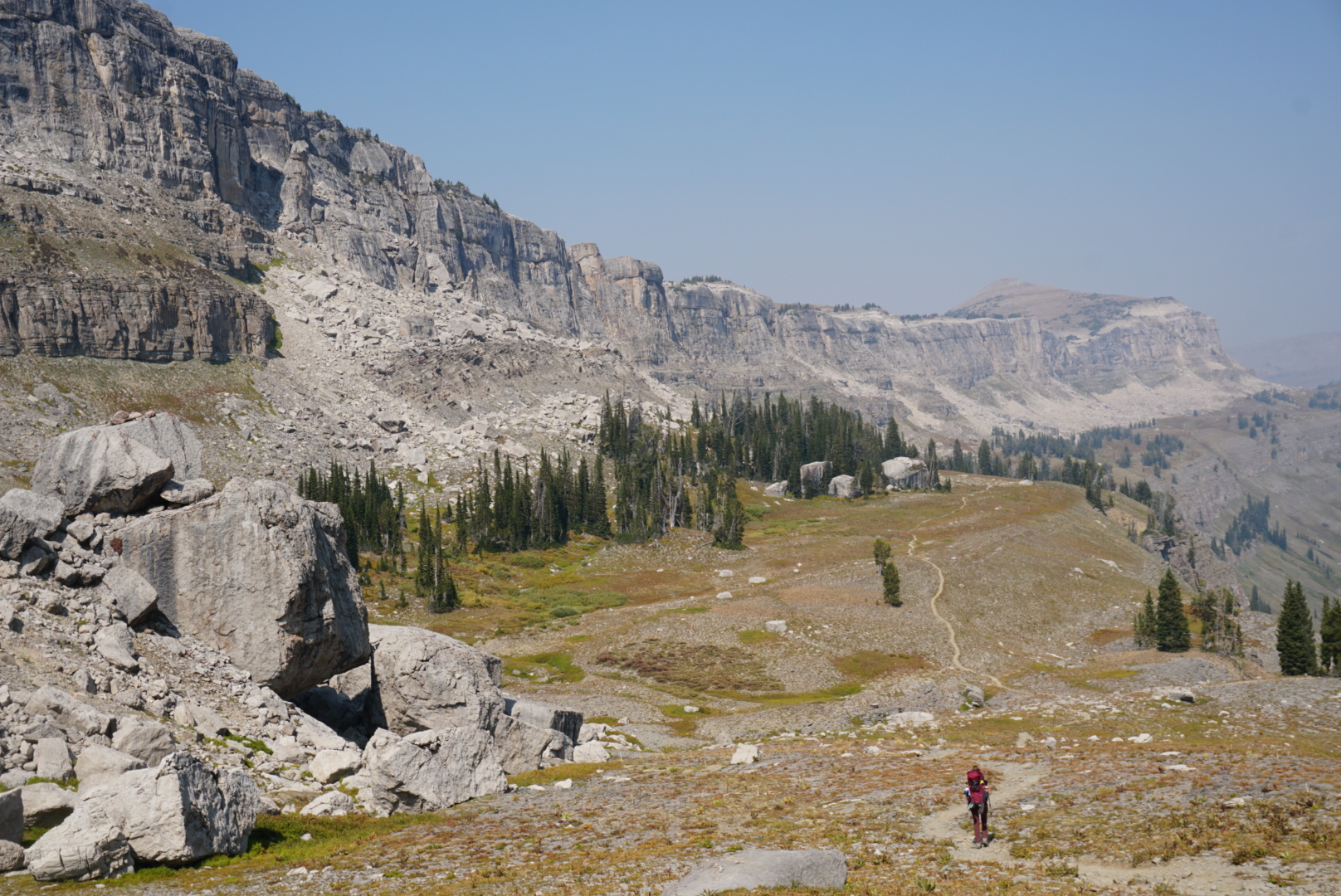
Beyond Fox Creek Pass, we entered what would be our favorite section of the day: Death Canyon Shelf. Aptly named, the “Shelf” is a wide 3.5 mile long ledge sandwiched between a sheer cliff on the left and the deep Death Canyon on the right. The views were incredible. For lunch, we stopped along the cliff’s edge and enjoyed a full view of the canyon, stretching all the way through the Teton Range and out to Phelps Lake. We also saw a handful of wildlife, including a rare family of bighorn sheep that appeared to dive off the shelf as we approached. Our favorite encounter, however, was with a burly, enterprising marmot. Unlike the ones near Marion Lake, he was busy foraging for fresh leaves and could not be bothered to take cover. Rather, he allowed us to get closer, then struck some poses for the camera before going on his way.
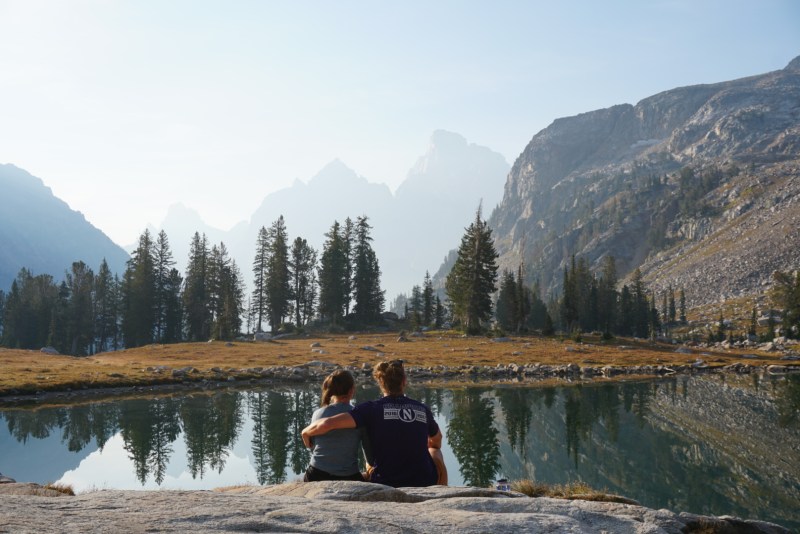
An hour or so before dusk, we concluded our journey on the Shelf by traversing Mount Meek Pass and beginning a steep descent down the “Sheep Steps” to Alaska Basin, where we would make camp. It was an all-time great campsite, tucked in amongst a set of gorgeous alpine lakes. After setting up the tent, we found the perfect lakeside spot for dinner and reveled in a colorful sunset. We finished our evening chores by lamplight, and as we finally packed back into the tent, we were treated to an unforgettable celestial display.


Day Three: Alaska Basin to North Fork Cascade Canyon (10.2mi)

Our third day on the Teton Crest really captured the essence of the route, a surplus of breathtaking scenery and wild trekking mixed in with a dash of suffering. Emma found that a minor ankle roll she endured the day prior had worsened overnight, making her hiking boots uncomfortable. As the day started with a series of taxing climbs, it surely was not the ideal day for wearing Tevas, nevertheless she endured without complaint.
After saying goodbye to our beloved campsite in Alaska Basin, we began a winding climb up a nearby ridge to Sunset Lake. If the elevation gain and thin air wasn’t enough to shake off the morning fog, an army of pika made sure we were awake and ready for the potentially treacherous switchbacks. As the path out of the basin overlapped vast scree fields characteristic of old landslides, it was the perfect habitat for this social clan of hamster-like rodents. Upon reaching Sunset Lake, we overtook two groups of backpackers who were still in the middle of their morning coffee. We contemplated a break, as we hadn’t had any social interaction over the past 36 hours or so, but ultimately, we still felt good and elected to keep riding Emma’s bad ankle to Hurricane Pass while it felt warm. This turned out to be a savvy move. We had proved to be hardy hikers over the first two days on the trail, but the Hurricane Pass climb was a new beast. The climb was itself was long, but a surfeit of false peaks made it seem endless. Time and again we drove to what we believed to be the “finish line”, only to find it a mirage, stretching into a further vertical climb.

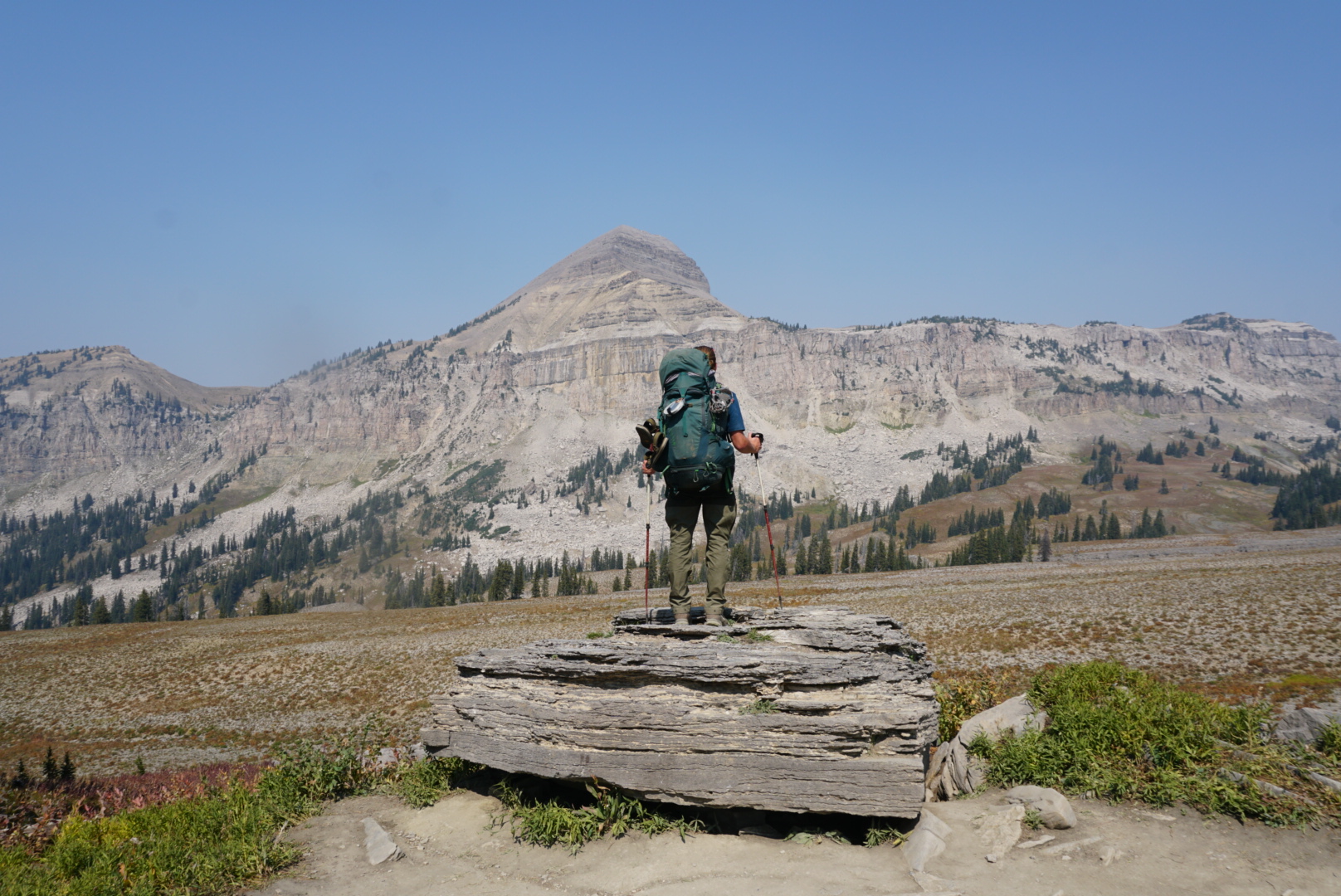
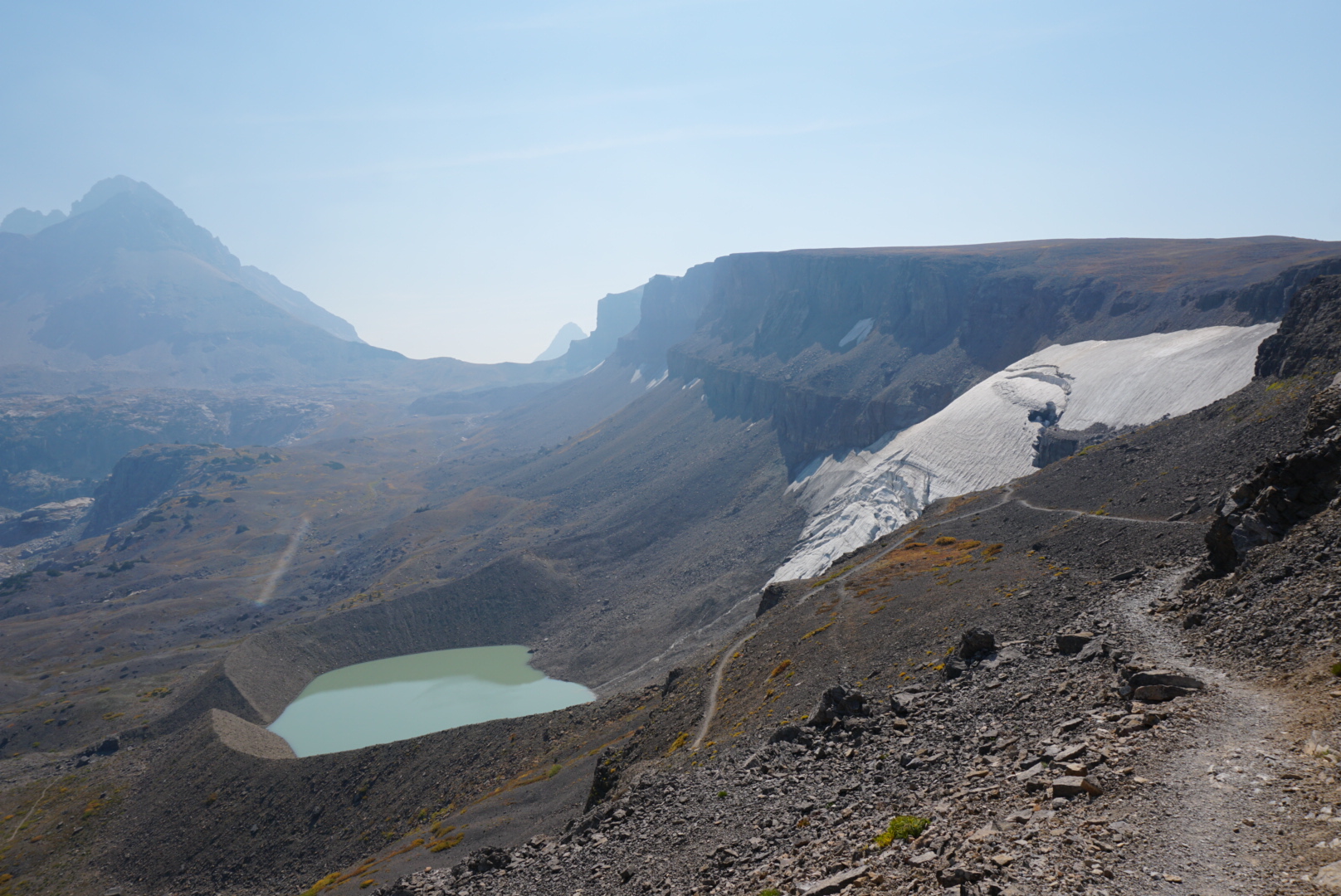
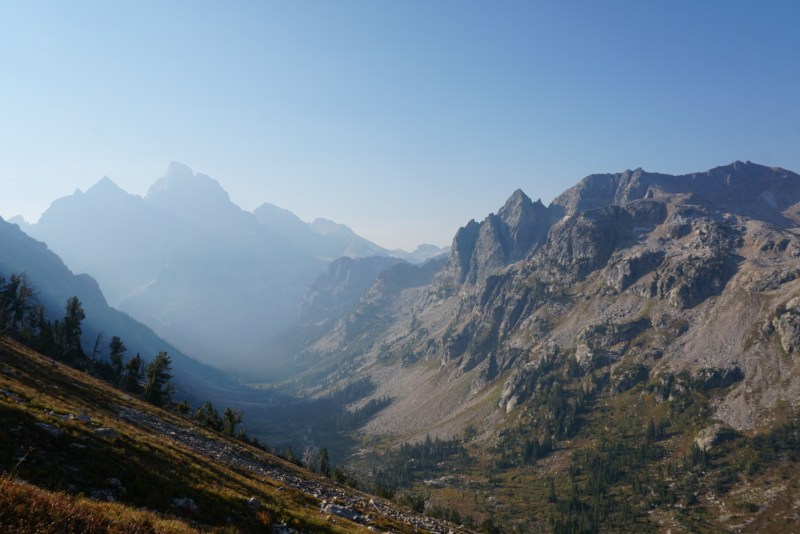
Triumph cannot be had without the struggle however, and the reward atop Hurricane Pass was well worth it. From the saddle, we were treated to spectacular, panoramic views of the Teton Range from “The Grand” to South Teton. As we moved closer, verdant Cascade Canyon and a series of glaciers came into view. Still recovering from our climb, we decided to cool off by laying down in a small glacier nearby. After soaking in the view and recharging with some fruit snacks, we saddled up and began a trek down into Cascade Canyon, our home for the rest of the day. Moving past the famous Schoolroom Glacier, which had receded beyond the trail completely, we ran into a group of backpackers headed uphill who alerted us that there were multiple moose in the canyon. Excited, we took off on at a quick clip, hoping for a safer, more reasonable encounter this time around.

As we hustled through the great canyon, re-immersed in the forest for the first time in a few days, we ran into a plethora of day hikers and weekenders who were exploring the canyon. Many regaled us with similar stories of a moose sighting “just back a mile or so”. After perhaps an hour of hiking we had given up hope entirely, and of course, that was when I finally spotted one. We had been coming down a moderately steep ridge, not too far from the end of the South Fork Camping zone, when I noticed a massive bull grazing in the open meadow below us. Silently, we dropped our packs, sat trailside, and watched as the moose went about his day. It was surreal. The moose must have stood at least 6ft. tall, and based on the breadth of his antlers, it was a marvel he could hold his head up at all. Eventually, our friend lumbered out of view to pull fresh branches from a tree, so we went on our way.

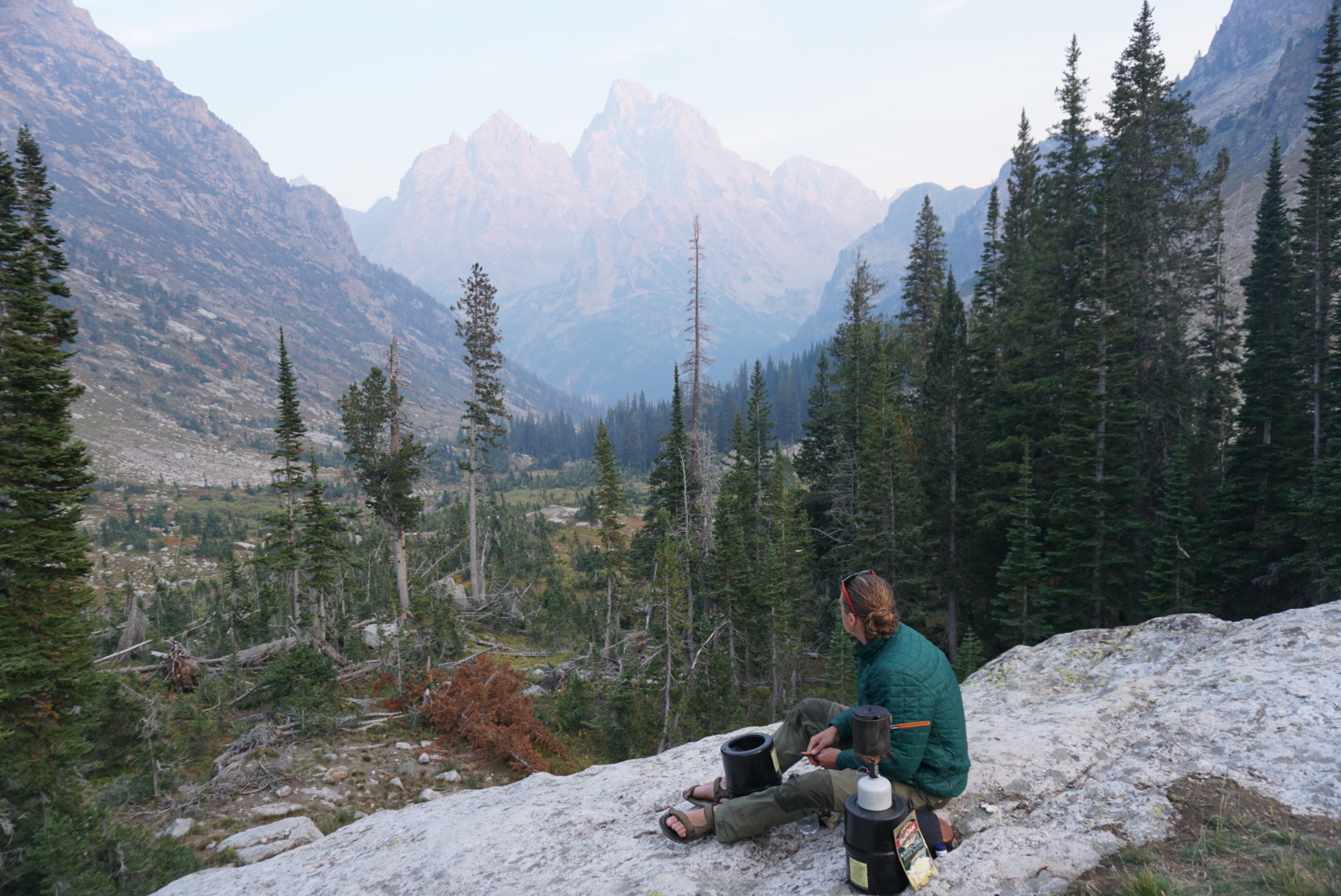
The sighting energized us for the rest of the afternoon, and aside from a long lunchbreak we took next to a trailside river, we made great time. As we were within a day’s hike of the Jenny Lake Lodge, this section of the trail turned out to be moderately populated. Despite hearing a few more stories of nearby moose and some black bear cubs, mule deer and marmots constituted the remainder of our day’s animal encounters. Approximately an hour before dusk, we reached a suitable campsite near the far end of the North Fork Cascade camping zone. A wash was long overdue, and the riverside spot was optimal for a pre-dinner sponge bath. The rest of the evening was spent enjoying dinner on top of an enormous boulder, which provided a picture perfect view of the Grand Teton framed by the steep canyon walls.


Day Four: North Fork Cascade Canyon to Jenny Lake Lodge (11.5mi)

By the end of our third day on the Teton Crest we felt like trail veterans, and our anxieties around grizzly activity faded, allowing for a better night’s sleep. This turned out to be to my detriment however, as I woke on day four to find one of my hiking poles had been knocked over and dragged across the campsite. Confused, I investigated further and found that there were small teeth marks and chunks that had been removed from the pole’s rubber handles, tell-tale signs of a mischievous marmot.

Our goal on day four was to get an early start, so boots met trail before the sun emerged above the canyon rim. Since we had come to the Teton’s alone and our car was at Phillip’s Bench, we knew we may have to try our hand at hitchhiking for the first time and felt an early end to the day would give us our best shot. Incidentally, the pre-dawn departure would also mean that when we arrived at the dazzling Lake Solitude, we had it to ourselves. As the sun broached the eastern wall and reflected off the glassy surface, it cast the entire canyon in an ethereal glow. Though our legs were fresh and water bottles near full, the moment felt sacrosanct, so we stopped for a good 45 minutes and took it in, finally moving on when the first set of backpackers emerged from the lower canyon.

Back on the road, we were quickly pulled from our reverie by a nasty climb right up the canyon wall. We knew it was coming and steeled ourselves. Having come to the terminus of Cascade Canyon there was nowhere to go but up; still, it was soul-crushing. The journey featured the longest single switchback I have seen in my entire life, and even as we toiled away, if never felt like we were making any progress towards the rim. Nearly a mile later, shouts and laughter from a group that had scaled the eastern wall signaled our arrival at Paintbrush Pass, the highest point on the Crest. After pausing for photos and socializing with some fellow Chicagoans, we began our final descent.

Aside from a tenuous downhill stretch immediately following the pass, the remainder of our day through Paintbrush Canyon and out to String Lake was pleasant. The grade was manageable, and the weather remained perfect. Though the Greater Yellowstone ecosystem is notorious for potentially harsh and unpredictable weather, it appeared we would make it through without seeing a single cloud. As we walked, we were reminded of signs in the visitor center that had warned of “increased bear activity in Paintbrush Canyon” by a number of passersby who reported sightings. Unfortunately, or fortunately (this question of our luck was debated much of the way down), we never saw any of the young black bears or grizzly and cub that had been reported “just down the way”.

When we reached String Lake and the rejoined society we were overjoyed, feeling a mixed sense of accomplishment and relief. A shower and proper meal were certainly in order and the only thing standing in our way was a lift back. Regrettably, our doubts towards a ranger’s assurances that we would be able to call a rideshare were confirmed, and we attempted hitchhiking. Just as we started to grow concerned, a group of friendly Ohioans that we had met on the trail offered to squeeze is into their sedan, thus concluding our unforgettable adventure in the Tetons.


Alternate Itineraries

If looking at an NPS map of the Grand Teton backcountry, you may notice that the actual Teton Crest has no trailhead. Rather the route is a thoroughfare that serves as the backbone of an expansive trail network on the west side of the mountain range. This means that there is no set path, and a number of modifications can be made based on campground availability, desired length, etc. I have listed out a handful of the popular itineraries below:

  1. Start at Phillips Bench (recommended): This is where we started and is perhaps the most popular route. It allows for a longer, more gradual approach to the Crest, and takes hikers across beautiful wildflower fields.
  2. Start at Jackson Hole Mountain Resort: A second popular route that allows hikers to leave from the popular ski area and then take a gondola up to the Rendezvous Mountain. This gondola ride makes this the shortest itinerary.
  3. Start at Granite Canyon / Rockefeller Visitor Center: A shorter, but much steeper, route that will connect to the Teton Crest via Granite Canyon Trail.
  4. Start at Taggart Lake (loop): This itinerary turns the route into a loop, which may be ideal for those with one vehicle that do not want to hitchhike. You may start at Taggart Lake, connect to the to the Crest via Granite Canyon, then use the Valley Trail to return to the trailhead.
  5. Start west of the park: While a vast majority of trekkers begin their journey from within the national park, the Teton Crest can also be accessed from the Jedediah Smith Wilderness via the Moose Greek, Game Creek, Fox Creek, or the Alaska Basin trails.

Additional Sources